海外華人眼中的春節(jié)
[ 2007-02-15 08:00 ]
|
英文中,“春節(jié)”為什么被稱為“‘Lunar’New
Year”?“年”是如何得來(lái)的?中國(guó)人過(guò)年都有哪些風(fēng)俗?……
關(guān)于“過(guò)年”,您自然一點(diǎn)兒也不陌生。不過(guò),若想把它送出國(guó)門之外,講給老外聽(tīng),似乎還是難了那么一點(diǎn)點(diǎn)。來(lái)吧,閱讀以下文字,相信會(huì)對(duì)您有所幫助。特感謝海外華人Bing
Wei貢獻(xiàn)此稿。 (注:Ms. Bing Wei is a published author in both
Chinese and English. A middle chapter of her first novel in English can be
read here:
http://chinaetiquette101-lifestyle.blogspot.com/2006/02/big-nose-and-me.html
)
|
特別推薦:獅子舞,猜燈謎,十二生肖
 The Chinese New Year celebration dates back to 2697 BC, when
the ancient tradition marking the end of winter and beginning of spring. The
start of the New Year is determined according to the Chinese Lunar calendar, a
system created to measure time based on the moon cycle. That is why the Chinese
New Year is also called the Lunar New Year or Spring Festival in China. Often
the first day of the Lunar New Year falls into January or February of the
Gregorian calendar. The Chinese New Year celebration dates back to 2697 BC, when
the ancient tradition marking the end of winter and beginning of spring. The
start of the New Year is determined according to the Chinese Lunar calendar, a
system created to measure time based on the moon cycle. That is why the Chinese
New Year is also called the Lunar New Year or Spring Festival in China. Often
the first day of the Lunar New Year falls into January or February of the
Gregorian calendar.
Many Asians cultures celebrate the lunar New Year as well as the Chinese. The
Vietnamese call it Tet Nguyen Dan, meaning "first morning of the first
day of the new year." The Korean names their new year "the first month of the
year" Jung Whur.
For the Chinese, traditionally the celebration lasts fifteen days, starting
by exploding thousands of firecrackers and ending with a Dragon parade.
Legend has it that a monster called Nian (meaning "year") used to
haunt and eat people on New Year's Eve. A Chinese village lit firecrackers (an
early version of gun powder) and pasted flaming red banners on their doors to
work magic. To celebrate, the whole village turned out, danced, feasted and
exchanged gifts. This gives birth to the lion dancing, dragon parade and giving
out money in little red envelopes for the New Year period.
New Year's Eve - The entire New Year observation starts with
New Year's Eve, called Chu Xi. For believers, they go to a temple to
pray for their ancestors as well as their own health and fortune for the coming
year.
Houses are cleaned and decorated with red paper cuts called Window
Flower (chuan hua). Many people gets a haircut too. A Chinese banquet
with foods of special meaning are prepared for the Eve. Often ten courses are
served as "ten" stands for perfection (Shi Quan Shi Mei). The fact that
family members gather for this special feast is believed to bring good fortune
and togetherness for the coming year. Fish are served whole to represent
completeness and plenteousness (Nian Nian You Yu). The noodle
symbolizes longevity. Year-cake (Nian Gao) is eaten, either savoury or sweet,
for the meaning of growing every year. By midnight, fireworks light up the sky
to scare away the monster and welcome the New Year.
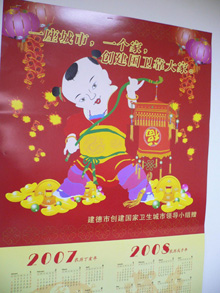 Red Envelope - The next morning, on New Year's Day, children
often receive a red envelope under their pillows. Only paper money (coins are
considered unlucky) are packaged with the meaning of prolonging their childhood
without having to grow too fast (Ya Sui Money). Golden characters for fortune,
happiness and prosperity are often written on these red envelopes. In Southern
China, the envelope is called Lai See in Cantonese hence the Lai See Money. Red Envelope - The next morning, on New Year's Day, children
often receive a red envelope under their pillows. Only paper money (coins are
considered unlucky) are packaged with the meaning of prolonging their childhood
without having to grow too fast (Ya Sui Money). Golden characters for fortune,
happiness and prosperity are often written on these red envelopes. In Southern
China, the envelope is called Lai See in Cantonese hence the Lai See Money.
Visitation - After breakfast people start to visit relatives
and friends by greeting each other "Happy New Year" or "Gong Xi Fa Cai" (May you
prosper). Guests typically bring simple yet meaningful gifts, such as apples for
peace and safety, oranges for good luck and sweets for happy life.
Lotus
seeds and peanuts are given to newly-weds(新婚夫婦) to bless them having many
children. People are expected to be on their best behavior on New Year's Day as
it is said that what happens on that day decides one's fortune for the entire
year. It is important that the visits be paid for the first two days of the New
Year. Otherwise, by the third day, the visiting will be considered impolite and
it also means you will not get along with those you visit too late.
| 1 | 2 |  |
|


