 Tea, that most quintessential of English drinks, is a relative latecomer to British shores. Although the custom of drinking tea dates back to the third millennium BC in China, it was not until the mid 17th century that the beverage first appeared in England.
The use of tea spread slowly from its Asian homeland, reaching Europe by way of Venice around 1560, although Portuguese trading ships may have made contact with the Chinese as early as 1515.
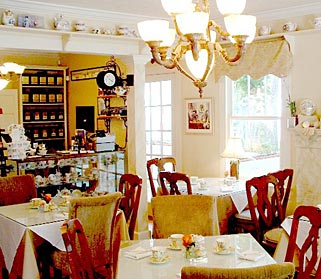
Tea shop in Chilham, Kent
It was the Portuguese and Dutch traders who first imported tea to Europe, with regular shipments by 1610. England was a latecomer to the tea trade, as the East India Company did not capitalize on tea's popularity until the mid-18th century.
Coffee Houses. Curiously, it was the London coffee houses that were responsible for introducing tea to England. One of the first coffee house merchants to offer tea was Thomas Garway, who owned an establishment in Exchange Alley. He sold both liquid and dry tea to the public as early as 1657. Three years later he issued a broadsheet advertising tea at £6 and £10 per pound (ouch!), touting its virtues at "making the body active and lusty", and "preserving perfect health until extreme old age".
Tea gained popularity quickly in the coffee houses, and by 1700 over 500 coffee houses sold it. This distressed the tavern owners, as tea cut their sales of ale and gin, and it was bad news for the government, who depended upon a steady stream of revenue from taxes on liquor sales. By 1750 tea had become the favoured drink of Britain's lower classes.
Taxation on Tea. Charles II did his bit to counter the growth of tea, with several acts forbidding its sale in private houses. This measure was designed to counter sedition, but it was so unpopular that it was impossible to enforce. A 1676 act taxed tea and required coffee house operators to apply for a license.
This was just the start of government attempts to control, or at least, to profit from the popularity of tea in Britain. By the mid 18th century the duty on tea had reached an absurd 119%. This heavy taxation had the effect of creating a whole new industry - tea smuggling.
Smuggling Tea. Ships from Holland and Scandinavia brought tea to the British coast, then stood offshore while smugglers met them and unloaded the precious cargo in small vessels. The smugglers, often local fishermen, snuck the tea inland through underground passages and hidden paths to special hiding places. One of the best hiding places was in the local parish church!
Even smuggled tea was expensive, however, and therefore extremely profitable, so many smugglers began to adulterate the tea with other substances, such as willow, licorice, and sloe leaves. Used tea leaves were also redried and added to fresh leaves.
Finally, in 1784 William Pitt the Younger introduced the Commutation Act, which dropped the tax on tea from 119% to 12.5%, effectively ending smuggling. Adulteration remained a problem, though, until the Food and Drug Act of 1875 brought in stiff penalties for the practice.
點擊查看本頻道更多精彩內容




