EXPLORATIONS -- a program in Special English by the Voice of America.
Voyager It was called the last great goal in flying. It would be a flight around the world without stopping or adding more fuel. Today, Frank Oliver and Doug Johnson tell about a special plane called Voyager and the effort to set a difficult world record.
VOICE ONE:
Voyager began as a quick drawing on a small piece of paper. Six years later, the drawing was a plane that made history.
Many people gave their time, energy and money to help make the flight happen. But three people had lead parts in the event: Dick Rutan, Burt Rutan and Jeana Yeager.
Dick Rutan was an experienced flier. He had been a pilot in the United States military during the war in Vietnam. After the war, he worked as a test pilot. He flew planes designed by his younger brother Burt.
Burt Rutan was well-known as a designer of experimental planes.
And Jeana Yeager held nine world flight records as a pilot.
VOICE TWO:
One day in early nineteen eighty-one, Dick, Burt and Jeana were eating in a restaurant in Mojave, California. Burt turned to his brother and asked a wild question: "How would you like to be the first person to fly around the world without stopping to re-fuel?"
The three considered the idea. A non-stop flight around the world without re-fueling was the last flight record to be set.
The flight always had been considered impossible. No plane could carry enough fuel to fly that far: forty thousand kilometers.
But now there were new materials for planes. Burt thought he could build a plane that could make the voyage. Dick and Jeana thought they could fly it. No one could think of a good reason not to try.
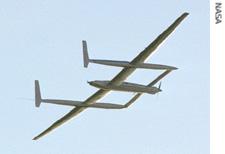
Burt picked up a small piece of paper. He drew an airplane that looked like a giant wing, and not much more. That was the beginning.
VOICE ONE:
Not since the days of Orville and Wilbur Wright had the people making a record flight designed and built their own aircraft. Dick, Burt and Jeana did. Some people thought their Voyager project was both impossible and foolish. Everyone knew it would be dangerous.
The Voyager crew worked on the plane in a small building at an airport in California's Mojave Desert. Dick, Burt and Jeana received no government money. Instead, they got small amounts of money from lots of different people.
As news of the project spread, more and more people offered to help. There were aviation engineers and workers from the space agency's experimental plane project. Several airplane companies offered equipment to be used in the plane. When Voyager was finished, it had two million dollars' worth of parts in it.
VOICE TWO:
Burt Rutan had built light-weight planes before. He knew a normal plane made of aluminum metal could not make a trip around the world without adding fuel. So his solution was to build Voyager almost completely out of new materials. The materials were very light, but very strong. This meant Voyager could lift and carry many times its weight in fuel.
The finished plane weighed just nine hundred kilograms, about the weight of a small car. The full load of fuel weighed three times that much, about three thousand kilograms. Voyager was not built to be a fast plane. It flew about one hundred seventy-five kilometers an hour.
VOICE ONE:
The main wing of the finished plane was more than thirty-three meters across. That is wider than the main wing on today's big passenger planes. The center part of the plane held the crew. And on either side of this body were two long fuel tanks.
In fact, almost all of the Voyager was a fuel tank. Seventeen separate containers were squeezed into every possible space. During the flight, the pilots had to move fuel from container to container to keep the plane balanced. One engine at each end of the body of the plane provided power.
The area for the two pilots was unbelievably small. It was just one meter wide by two-and-one-quarter meters long. The person flying the plane sat in the pilot's seat. The other person had to lie down at all times.
VOICE TWO:
After many test flights, the Voyager was finally ready in December, nineteen eighty-six. The best weather for flying around the world is from June to August. That time was far past. But the pilots were tired of delays. They made the decision to take off, knowing the weather might be bad.
On December fourteenth, Dick Rutan and Jeana Yeager walked around the plane one more time. It looked like a giant white flying insect. They were going to be trusting their lives to this strange plane for the next nine days.
Dick climbed into the only seat. Jeana lay on the floor. They were ready to go. Flight controllers at Edwards Air Force Base in California cleared them for a trip no one had ever attempted before.
VOICE ONE:
The long, thin wings of the plane were so loaded with fuel that they almost touched the ground. Voyager began to move down the runway, slowly. But something was wrong. The ends of the wings were not lifting.
Burt Rutan sent a radio message to his brother to lift the plane's nose. "Pull back on the stick!" he screamed. "Pull back!" But Dick did not hear the warning. And he did not see the wings. He was looking straight ahead.
Voyager was getting dangerously close to the end of the runway. It appeared about to crash. Finally, just in time, the long wings swept up. The plane leaped into the air.
Planes following Voyager could see that the ends of the wings were badly damaged. Dick turned the plane so the force of air currents would break off the broken ends. Then he aimed Voyager out over the Pacific Ocean.
VOICE TWO:
Weight was the main consideration in designing the experimental plane. Not safety. Not comfort. Voyager did not have most of the normal safety equipment of modern planes. There were no special materials to block the noise of the engines. And space for the pilots was so tight they had great difficulty changing places.
Voyager's long wings moved up and down as the winds changed. It seemed to sail on waves of air, just like a sailboat on ocean waves. This motion meant the flight was extremely rough.
VOICE ONE:
It was not an enjoyable trip. Dick and Jeana were always tense. At the end of the second day, the weather expert for the flight warned of trouble. Voyager was heading for an ocean storm. Dick was able to fly close to the storm and ride its winds.
On the third day, Voyager was in trouble again. It had to fly between huge thunderhead clouds on one side and Vietnam's airspace on the other. Dick was able to keep the plane safely in the middle.
Over Africa, the two pilots struggled with continuous stormy weather. Dick had flown almost all of the first sixty hours of the flight. Then he changed places with Jeana for short periods. Both were extremely tired.
Suddenly, a red warning light turned on. It was a signal that there was not enough oil in one engine. Dick and Jeana had been so busy trying to fly around bad weather and mountains that they had forgotten to watch the oil level. But luck stayed with them. They added the necessary oil. The engine was not damaged.
VOICE TWO:
Once past the violent weather over Africa, Dick and Jeana began planning the way home. A computer confirmed that they had enough fuel left to make it. But as they flew up the coast of Mexico, the engine on the back of the plane failed. Fuel had stopped flowing to it.
The more powerful front engine already had been shut down earlier to save fuel. With neither engine working, Voyager quickly began to lose speed and height. The plane fell for five minutes. Dick finally got the front engine started again. Then fuel started flowing to the back engine, and it began to work again, too.
VOICE ONE:
Nine days after take-off, Voyager landed smoothly at Edwards Air Force Base in California. It had completed a forty thousand kilometer flight around the world. It had not stopped. And it had not re-fueled.
Dick said after landing: "This was the last major event of atmospheric flight." Jeana added: "It was a lot more difficult than we ever imagined."
Burt Rutan's revolutionary plane design had worked. And, with it, Dick Rutan and Jeana Yeager had joined the list of the world's greatest fliers.
(MUSIC)
This Special English program was written by Marilyn Rice Christiano. Your narrators were Frank Oliver and Doug Johnson. I'm Shirley Griffith. Listen again next week for another EXPLORATIONS program on the Voice of America.