
中國網(wǎng)站品牌欄目(頻道)
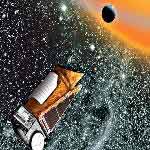
Scientists on Monday reported the first new worlds discovered by the Kepler Space Telescope, which was launched in March last year specifically to find planets orbiting distant stars.
Kepler was designed to look for planets like Earth, but the first discoveries are much bigger planets - four of them bigger than Jupiter, and a fifth roughly the size of Neptune.
NASA scientist William Borucki says these planets race around their stars so fast, that their years are measured in days.
"The orbital periods run from about 3.2 days to 4.9 days. So these are very short orbits. The short period orbits also tell us that the planets are orbiting close to their stars, and consequently you're going to see they're quite hot."
How hot? Astronomers use the Kelvin scale, which starts at absolute zero. So, frigid Jupiter is 124 Kelvin, Earth is about 300 Kelvin. "If you continue going up in temperature, you see molten lava at about 1300 Kelvin," said Borucki. "The planets we found are all hotter than molten lava. They all simply glow with their temperatures. Looking at them might be like looking at a blast furnace. They are very bright in their own right."
Borucki and other Kepler astronomers discussed the newly-discovered planets at the American Astronomical Society meeting in Washington.
The Kepler orbiting telescope can't see planets directly. Looking into deep space with even the best telescope, you can't see a planet next to the large, bright glare of the star it's orbiting. So instead, astronomers look for the light of the star to dim slightly as a planet passes in front of it. That's how the five new worlds were identified.
Kepler is continuously monitoring more than 100,000 stars considered likely to have planets. The challenge is weeding out false positives, when a star dims for some other reason.
"Well, fortunately we have a very well laid out plan for vetting out these false positives." San Jose State University astronomer Natalie Batalha told reporters that some of those false positives can be eliminated by the precision and stability of Kepler's observations. But in other cases, astronomers rely on ground-based observations to confirm findings from Kepler. It required almost 100 nights of observations from telescopes in the U.S. and the Canary Islands to confirm discovery of the five planets reported this week.
"So that gives you a feel for the process, how long it takes from start to finish and how careful we are in confirming and making sure these are real signals," she said.
Kepler's high precision is not just useful in identifying new planets around distant stars. It can tell astronomers something about the stars themselves, as well as providing more detailed information about the planets it is discovering.
Ron Gilliland of the Space Telescope Science Institute says the size of one star was measured by ground telescopes to an accuracy of plus or minus 10 percent; with Kepler, the uncertainty was reduced to just 1 percent. And likewise, Kepler has refined measurements of a planet in orbit around that star.
"Before Kepler, we would have known the density of the exoplanet orbiting this star to maybe 50 percent accuracy. After Kepler, we should know that to about 5 percent accuracy. And that's absolutely critical to hope to understand the interior structure of the planets."
One other conclusion from these first Kepler observations: many of the 100,000-plus stars in Kepler's sights are less active than had been expected - less active in the sense of having fewer storms that would give off bursts of radiation that might threaten life on planets orbiting them.
Caty Pilachowski of Indiana University says this bodes well for those hoping to find conditions that are hospitable to life on these distant planets.
"It's good news for astrobiology because if most stars are quiescent, if stars don't become terribly active, then they don't scour the surfaces of their planets, and we're more likely to have habitats where life might evolve. And it increases our chances of finding that life down the road."
Scientists working with Kepler say they're happy with the results they're getting. And they're looking forward to collecting a lot more data in the months and years to come that will enable them to identify planets more like Earth.
molten lava: melted rock that flows from a volcano or from a crack in the Earth 熔巖
false positive:假陽性
vet: to investigate carefully 仔細(xì)調(diào)查
exoplanet: a planet that orbits a star in a solar system other than that of Earth 外星行星
quiescent: quiet; not active 沉寂的;靜態(tài)的
scour: to make a passage, hole, or mark in the ground, rocks, etc. as the result of movement, especially over a long period 沖刷成;沖刷出
美宇航局發(fā)現(xiàn)火星細(xì)菌 成生命新證據(jù)
Widespread water found on surface of moon
NASA's Kepler satellite to seek distant Earth-like planets
(來源:VOA 編輯:陳丹妮)
 |
 |
 |
 |
 |
 |