Elegant collision between East and West
Western Music to An Emperor's Ears In 1670

In 1670 Emperor Kangxi, second emperor of the Qing Dynasty, ordered all the Western missionaries who were able to play musical instruments to form an orchestra and play a sonata composed by Italian missionary Teodoricus Pedrini. This performance was the first time a sonata was played in China. But many of the players were not skilled musicians and the concert ended with the vexed emperor dismissing the rag-tag orchestra.
But what Kangxi heard aroused a strong interest in Western music. A couple of days later, the same band was summoned to play in the palace again.
The emperor listened attentively to the four-hour recital and became totally absorbed in the music. During the more exciting passages he took part himself.
The diary of one missionary reveals that the emperor loved music and longed to become a musician, despite his lack of talent. The emperor liked Pedrini's music and listened to his recitals frequently. He ordered Pedrini to teach Western music to Chinese students including his two sons.
Elegant Collision of Water Colors and Western Oils
|
|
Emperor Yongzheng of the Qing Dynasty (1644-1911) in western style suit. |
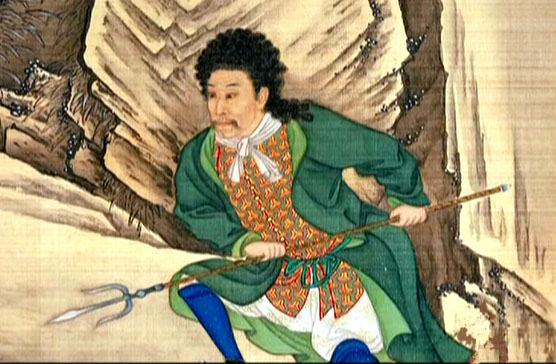
Despite their intentions, European missionaries became known to the Chinese more for their skills in art and science than for Christian messages they were sent out to preach. Along with clocks and Western music, European oil painting was introduced to China by the missionaries, of whom some were skilled oil painters.
Gradually accepted by China's upper class, foreign painters, combining Western oil painting with Chinese traditional techniques, got chance to work in the Imperial Court.
Giuseppe Castiglione, the Italian artist, was the most famous Western painter in China during this period.
Castiglione
In 1714, a trading ship stopped in Guangzhou with seven foreign missionaries on board. The news was immediately reported to Emperor Kangxi, who ordered the missionaries with scientific knowledge to the capital and sent the others back. Among those allowed to stay was Giuseppe Castiglione.
Castiglione was invited to the palace by Emperor Kangxi, who, impressed by his painting talent, ordered him to study traditional Chinese painting. For the next 50 years, Castiglione served as an imperial artist, witnessing the comings and goings of three emperors -- Kangxi, Yongzheng (1678-1735) and Qianlong (1711-1799).
Castiglione adjusted his oil painting style to suit the emperors' tastes and traditional Chinese aesthetics by using Chinese rice paper, thin silk, ink and brush pens. However, his unique combination of Western and Chinese painting styles was the only way he could survive the whims of the imperial court.
In 1762, 16 paintings made by Western artists in China were sent to France to be made into dry points, an engraving method in which the design is scratched directly onto the (usually copper) plate with a sharp pointed instrument.
The paintings, depicting border insurgency wars between 1755 and 1761, were reproduced by seven well-known etchers, who spent 7 years on them. In 1773, the original paintings along with their drypoint versions were sent back to the Forbidden City.
The Struggling Evolution
|
|
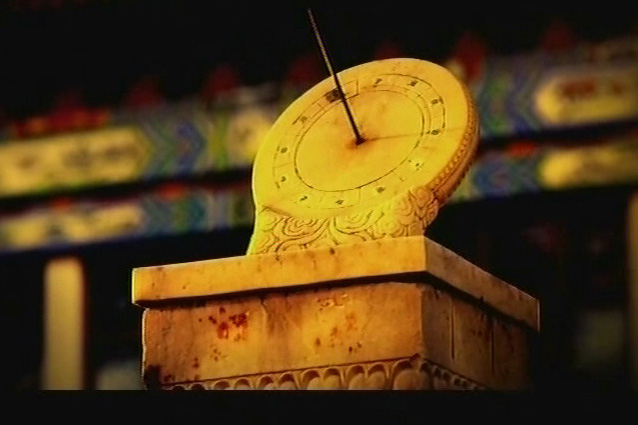
The cultural exchanges in the 17th and 18th centuries also prompted the scientific development of China and the growing of great Chinese scientists.
A Chinese Catholic Scientist
Xu Guangqi (1562-1633) was a great scientist in Chinese history. He was acquainted with Italian missionary Matteo Ricci, whom he frequently met with to discuss Western science.
The friendship with Ricci changed his life. Xu learned Western mathematics, astronomy, geodesy (the science of measuring the size and shape of the earth) and hydraulics. He put them into use in the farming and salt industries.
An official of high ranking, though, Xu was a Catholic. He worked together with Ricci on the translation of Original Text of Geometry.
On June 21, 1629, there was a solar eclipse. Xu accurately forecast the phenomenon by using Western astronomy. Inspired by Xu's precise calculation, Emperor Chongzhen ordered the establishment of a new Bureau of Astronomy.
Xu was assigned to be in charge of the bureau and the Jesuits were invited to take part in the composition of new calendars. Since then, more books on Western astronomy and Gregorian calendar theories were introduced to China systematically.
After Matteo Ricci, more missionaries skilled in science and technology gained access to the Forbidden City, including German missionary Johann Adam Schall von Bell (1591-1666) and Belgian Ferdinand Verbiest (1623-1688).