Heritage
Nuo dance
(chinaculture.org)
Updated: 2007-11-19 09:49
 |
Large Medium Small |
(Nanfeng Nuo Dance, Wuyuan Nuo Dance, Le'an Nuo Dance)
Year: 2006
Sort: Folk Dance
Area: Jiangxi province
Serial No.: III-7
The Nuo dance, which once was used to exorcise evil, is now entertainment.
China's Nuo dance, which originated in primeval times as a means of exorcising the plague and demons and worshiping gods, is the oldest dance form known in the country. The Nuo dance used to be performed in most parts of China, by Han people as well as by some ethnic minority groups in Southeast China.
Emerging in feudal times, when ancient Chinese were transforming from barbarism to civilization, the Nuo dance served as a talisman against the perceived evils of life. During this period, natural disasters and diseases, especially plagues, often wiped out huge segments of the population and livestock. Desperate for an explanation of such abnormal occurrences, primitive Chinese assumed that demons and ghosts were behind these inexplicable events, which was in fact the beginning of primeval worship of nature, totems, ancestors, and deities. During the Shang and Zhou dynasties (16th century-3th century BC), sacrificial rites such as the Nuo dance to exorcise evils appeared. In the Zhou Dynasty, Nuo became a major rite of the court.
The Nuo dance takes on diverse forms. There are Nuo dances specially designed for various purposes, such as to ward off evil and plague, to entertain and thank deities, to pray for fortune and good luck, and to bring to life favorite legends and myths, which represent the wide range of cultural norms in China.
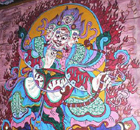
The dance is vigorous and dignified. The dancers of the Nuo Dance all wear vivid, lifelike, wooden masks with different expressions, some of which are powerful and bold, some ferocious, some amiable and kind, some simple and naive, and some smiling and lovely. The dancing forms are rich and the movements diverse: some of which are agile and brave, some simple and powerful, and some nimble and bright. In these movements, there are a lot of elements of marital arts and opera postures, so it has specific flavors and characters.
As society evolved with a growing economy and more advanced technology, the Nuo dance began to lose popularity in most parts of China. Now it is only performed in remote townships and ethnic minority areas as a form of ancient sorcery. In some areas, the Nuo has been transformed into a folk dance simply for entertainment, replacing solemnity and mystery with artistic expression.
Nanfeng Nuo Dance
Declarer: Nanfeng county, Jiangxi province
The Nuo dance is a favorite folk dance in the villages of Nanfeng county. According to local history, the Nuo dance was performed in Nanfeng in the Han Dynasty (206 BC-220 AD) to dispel evil spirits. During the Ming and Qing period (1368-1911), the Nanfeng Nuo Dance absorbed various performing feats from operas, puppet shows, and martial arts and gradually developed into an entertainment. It currently preserves 82 dance forms, 180 sorts of masks, and 5 kinds of props including weapons, religious instruments, lighting, food offerings, and daily outfits.
Wuyuan Nuo Dance
Declarer: Wuyuan county, Jiangxi province
The Wuyuan Nuo dance, also known as the Ghost dance, is a 'living fossil' in terms of researching primitive Chinese dancing. It currently has more than 100 repertoires and over 200 masks. The Wuyuan Nuo dance tells fairy tales and folk legends with its unique primitive, straightforward, exaggerated, and vivid performance.
Le'an Nuo Dance
Declarer: Le'an county, Jiangxi province
The Le'an Nuo dance, also known as the Rolling Nuo Deity by the locals, has a history of about 1,000 years. It is a ritual to dispel evil, pray for good fortune, and safeguard the people and their home. The uniqueness that differentiates it from other Nuo dances lies in its mask, which, instead of a whole face, is made up of only a forehead and mouth. There are 18 sorts of mouths, such as snout or chicken mouths, which are rarely seen in other Nuo dances. Its accompanying music and primitive dance movements are also particular. The Rolling Nuo Deity is by far the only most primitive Nuo ritual and dance to survive.?