Heritage
Yungang Grottoes
(chinaculture.org)
Updated: 2007-11-21 14:32
 |
Large Medium Small |
Located at the southern foot of Wuzhou Mountain, some 16 km west of Datong city, Shanxi province, the Yungang Grottoes were built against the mountain and extend about 1 km (0.62 miles) from east to west. The construction of the caves was started under the auspices of the noted monk Tan Yao in 453 during the Northern Wei Dynasty and took 50 years to complete. Some 40,000 people, including Buddhists from what is present-day Sri Lanka, contributed to the huge endeavor.
The 53 grottoes in Yungang include some 1,000 niches with about 51,000 statues - a treasure trove of grotto art that combines traditional Chinese art forms with foreign influence, particularly Greek and Indian. The Yungang Grottoes are also a treasure house of ancient Buddhist art, the largest of its kind in China. They are as famous as the Longmen Grottoes in Luoyang and Mogao Grottoes in Dunhuang, Gansu province.
The numerous niches set in the northern cliff of Wuzhou Mountain look like a honeycomb. The grottoes, a plethora of Buddhist statues, are composed of the following three parts: the early rock caves (five) in the west, which are mostly oval-shaped and planned on a large scale, with the main statue reaching a height of 17 meters; the grottoes in the middle, oblong in shape and in two chambers, with the main statue in the center and the walls, arches and roofs covered with Buddhist relief sculptures; the square grottoes, each with a pagoda-shaped central column, also excellently sculptured, reaching to the roof while the walls are carved with niches enshrining Buddhist statues.
Caves 1 and 2 are located in the east zone. Statues and sculptures inside these caves have been severely damaged by exposure to the elements, but still preserved in the east zone are relief sculptures of Buddhist stories on the lower part of the eastern wall of Cave 1. Inside the entrance to the Yungang Temple is an impressive four-storied wooden fa?ade with a glazed top outside Caves 3, 4 and 5.
Most of the grottoes are in the western zone, and each has its own character. Cave 20 - one of the five earliest caves of monk Tan Yao - houses the sitting statute of Sakyamuni, which is 13.7 meters high, with a full and round face, majestic smile, slim lips and a high nose, ears that extend almost to the shoulders, radiant eyes, and broad shoulders. The Sakyamuni statue is representative of the Buddha sculptures of the Yungang Grottoes.
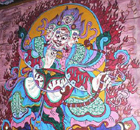
Tours normally begin from the second group ranging from Cave 5 to Cave 13. Yungang art manifests itself best in this group. Grotto No 5 contains a seated Buddha at a height of 17 meters. In Cave 6, a 15-meter-high two-storied pagoda pillar stands in the center of chamber, and the life of the Buddha from birth to the attainment of Nirvana is carved in the pagoda walls and the sides of the cave. The Bodhisattva was engraved in Cave 7. The rarely seen Shiva Statue in Yungang, with eight arms and four heads, riding a bull, is illustrated in Cave 8. Cave 9 and 10 are notable for their front pillars and figures bearing musical instruments. Musicians playing instruments also appear in Cave 12. Cave 13 has a Buddha statue with a giant figurine supporting its right arm.
The rest of the caves belong to the third group. Cave 14 has been eroded severely. Cave 15 was named the Cave of Ten Thousand Buddha. The caves numbered 16 to 20 are the oldest complex and each symbolizes an emperor from the Northern Wei Dynasty, with subject of "Emperor is the Buddha." The caves from Cave 21 onward were built later and cannot compare to their better-preserved counterparts.
In the past 1,500 years since their completion, the Yungang Grottoes have been damaged by both war and natural disasters. After the founding of the People's Republic of China in 1949, the Chinese government attached great importance to the preservation of the grottoes. A special Yungang Grottoes protection institution was set up in 1995, and, in 1961, the State Council listed the Yungang Grottoes as a key cultural site under its protection. In 1965, the Datong Municipal Government issued and implemented the Programs for the Protection Scope and Safety of the Yungang Grottoes. From 1973 to 1976, under the instruction of Premier Zhou Enlai, China injected a huge sum of money into the grottoes, rescuing many grottoes and caves that had been on the verge of collapse.
In the past decade, the Datong Municipal Government has intensified its efforts to protect the Yungang Grottoes. Huge investments have been made to prevent illegal construction and intensify landscaping efforts at the site. In December 2001, the 25th meeting of the UNESCO World Heritage Committee in Helsinki, Finland, passed a decision to list the Yungang Grottoes on the World Cultural Heritage List.