Ancient Chinese shoes
China has diverse customs and styles as regards its traditional dress culture, and the abundance and variety of Chinese footwear justifies its being singled out from other items of apparel to be studied separately as “shoe culture”. Footwear is an interesting facet of the many aspects of Chinese culture.
 |
|
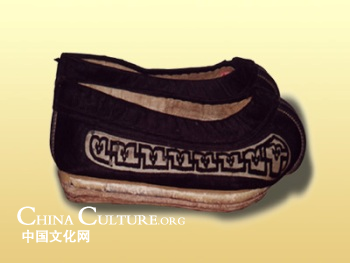
Men’s palace shoes during the Qing Dynasty were straightforward. They were slim but virile. |
From “Foot Clothing” to Leather Boots
Ancient Chinese distinguished the main items of dress as “upper clothing,” “l(fā)ower clothing” and “foot clothing,” the latter referring to both shoes and socks. In the ancient script engraved on bone and tortoise shell it depicts a whole animal hide that has been trimmed and stretched out. This would indicate that, at the time written Chinese was being formulated, socks and shoes were both related to leather. In ancient times there was, in fact, no distinction between shoes and socks. The ancients would protect their feet by cutting out pieces of animal hide, wrapping them around their feet, and securing them with leather thongs. According to archaeologists, this kind of foot wrapping first appeared in the Old Stone Age.
Later, in the process of making footwear ancient people learned to use bone needles, to dry and hammer animal tendons thin enough to use as thread, to dye animal hides with animal fats and plant juices, and to rub the hides with their hands to make them soft. This practice formed the basis of the method through which shoes would later be made.
The earliest pair of leather shoes in existance in China is a 4,000-year-old pair of boots made from sheep hide, worn by a mummified female corpse discovered in the ruins of the ancient kingdom of Loulan, in the deserts of Xinjiang Uygur Autonomous Region. The lower and upper parts were sewn together using thick hide threads.
The ancient nomads of north China wore boots made from a variety of materials. Tibetan boots were made of yak hide, the Oroqen people used roe deer hides, and the Hezhen people used fish skin. The Huns were more sophisticated in their boot-making methods and used sheep wool rolled into felt as their basic material.
Leather boots were first introduced into the Central Plains area by King Wuling of the State of Zhao during the Warring States Period (475–221 BC). In 325 BC, threatened by contending states, King Wuling decided to replace his warring chariots with mounted archers. The king dispensed with the traditional loose robes and wooden soled, flax-fabric shoes normally worn in battle, dressing his cavalrymen instead in tunics, pants and boots modeled on the attire of the northern nomads, thus making his troops one of the strongest and best protected of the time.
 |
|
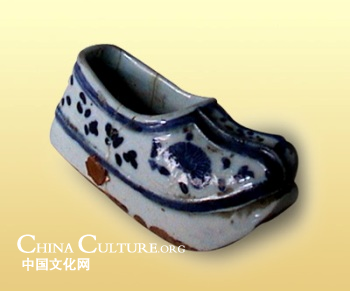
White china shoes in the Qing Dynasty. This pair of china shoes is beautifully colored and exquisitely shaped. |
Straw Shoes and Wooden Sandals
While China’s northern and northwestern people were sewing hide boots with bone needles and hide thread, people in the east were making straw shoes using bamboo needles and flax thread. Archaeological finds show that as early as 7,000 years ago, ancient Chinese had learned to make articles of daily use from plant fibers. Certain researchers believe that bamboo needles and flax thread date back even further than bone needles and hide threads.
A Chinese legend tells how straw shoes came into being: An impoverished old man eked out a living by chopping up and selling firewood. When fetching wood from the mountains, he often injured his feet on thorns and pointed stones, and so would wrap his wounded feet in wild grass. However, as the grass would inevitably come loose and fall away, he devised a way of twisting it into ropes, which he then tied around his feet. Still later he wove this rope into a sole and instep to facilitate the wearing and taking on and off of this footwear.
Many kinds of grass can be used to make shoes. In ancient times, therefore, almost all people across China wore straw shoes, excepting only nomadic tribes. The main difference in mode of this footwear was that people in the frigid north wore thick straw boots, while those in the hot, humid south wore straw sandals. Straw footwear was worn by all, whether they were nobles, men of letters or farmers. Along the eastern coast of Shandong Province, farmers would wear “straw nests” — boots woven tightly with the stems and leaves of cattail or corn leaves — in the depths of winter. These materials were most effective in keeping the feet warm and, even today, local farmers still weave this kind of boots for export.
In Shandong Province, straw boots were attached to wooden soles, making them a combination of straw shoes and wooden sandals, the latter originating from the Warring States Period (475–221 BC). They came in two styles, with either flat or ridged soles. In later years, poet Xie Lingyun (385–433), a keen mountaineer, invented removable ridges. When going uphill, he removed the ridges from the front of the sole, and when going downhill, from the heels.
 |
|
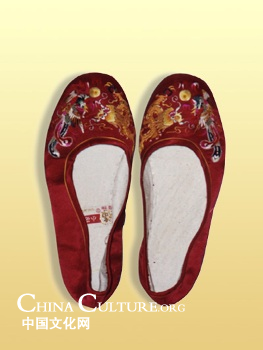
There was a shoe shop named “Little Garden” in Shanghai at that time. It only made stitch soled shoes. |