Ancient Chinese shoes
Military, Cloth and Silk Shoes
From the ruins of the Yin and Shang Dynasties (14th–12th centuries BC), archaeologists have unearthed, on independent occasions, a pair of leather shin guards and a headless, kneeling jade human figure, whose shins show traces of wrapping. According to historical records, before military boots were invented, soldiers wrapped pieces of hide and rattan around their shins for protection, and certain scholars believe that military boots were developed from these beginnings.
Examination of the terra-cotta warrior figures of the Zhou Dynasty (1100–256 BC) unearthed in Shanxi’s Houma City shows clearly that the neat stitching on the soles of their footwear is exactly the same as that seen on the stitched soles of hand-made cloth shoes today. This discovery indicates that stitch-soled cloth shoes were invented for military wear over 2,000 years ago. However, before cotton was introduced into China along the Silk Road at a later time, ko-hemp and flax were used for the stitching of shoes, when the flax stitching in particular made soles both durable and stable. Within the ranks of the underground terra-cotta army of Emperor Shihuang of the Qin Dynasty (211–206 BC), generals and cavalrymen wear leather boots, while archers wear square-headed, stitch-soled cloth shoes with a strap across the instep. This shows that standardization of uniforms according to military ranks and services had already been adopted at the time.
In the Qing Dynasty (1644–1911), military boots were adapted for civilian wear and also became part of the uniform for officials. Boots came in the two styles of pointed or square-toes, the former being for everyday wear, and the latter for court attendance. The soles of these boots were made from 32 layers of cloth and were later used in the making of the cloth shoes worn by the common people, which have since become known as One-Thousand-Layered shoes. To allow such soles to breathe, as well as being elastic, water-proof, and warp-proof, 100 stitches per square inch of the sole were required. On completion of this stitching, the sole would be soaked in water at a temperature between 80 and 100 degrees Centigrade, and would then be hammered, shaped and dried. Today this style of shoe is still popular, abroad as well as within China.
Silkworm breeding started about 5,000 years ago in China. In the Shang Dynasty, some 3,000 years ago, people learned how to weave silk cloth and color it with mineral and plant dyes. The development of sericulture greatly influenced Chinese shoe making, and colorful silk shoes gradually replaced straw shoes.
 |
|
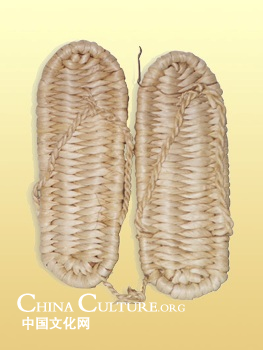
Straw sandals have existed from ancient times up until today. There are many kinds of straw sandals. |
Etiquette
The ancient Chinese had many rules of etiquette within their daily lives, which included their footwear. The rules of the Zhou Dynasty (1100–256 BC) stipulated that people should take off their shoes before entering the house, that shoes and socks should be removed at banquets, and that ministers meeting with the emperor should also take off both shoes and socks. However, bare feet were a taboo on occasions of ceremonial worship.
In ancient China, different shoes were worn to suit particular occasions. Wedding shoes were either pink or red, and embroidered with auspicious bird and floral patterns. In the Han Dynasty (206 BC–220 AD), brides wore wooden sandals painted with floral patterns and tied with five colorful silk straps, and Manchurian brides of the Qing Dynasty wore blue cloth shoes embroidered with the red double “happiness” characters.
Shoes for the deceased were known as “Longevity Shoes,” relating to their future eternal wear in the afterlife. Between 206 BC and 420 AD, upon their death, all emperors wore jade shoes. In the Qing Dynasty, when an emperor died, all his shoes were burned. When Emperor Guangxu (1875–1909) died, 104 pairs of his shoes were cremated. For ordinary people, Longevity Shoes came in blue, black or brown for men, while women wore brightly colored embroidered shoes. The soles would be embroidered with the pattern of a lotus flower and a ladder, symbolizing the ascent of the departed to heaven. However, older people who really were celebrating their longevity and hoping for happy returns wore “Happy-Character” shoes — shoes embroidered with the Chinese character meaning “happiness.”
In feudal China, the social status of people could be perceived from the shoes they wore. In the Southern Dynasty (420–589), ordinary people were permitted to wear straw or coarse-fiber cloth shoes colored in blue, green or white only, while nobles wore leather and silk shoes. The Western Jin (265–317) ruler, in his distaste for merchants, and wishing them to be immediately distinguishable, decreed that their footwear should comprise one black and one white shoe. The Qing Dynasty stipulated that bright yellow footwear was reserved solely for the emperor, golden yellow shoes were for nobles, and those of an apricot-yellow shade were for the common people.
The changes in Chinese shoe culture reflect its close connection with the natural and geographical conditions of China, and also manifest social, economic and cultural changes, as well as the likes and dislikes of rulers and the common people of different periods.
Interesting Shoes
|
|
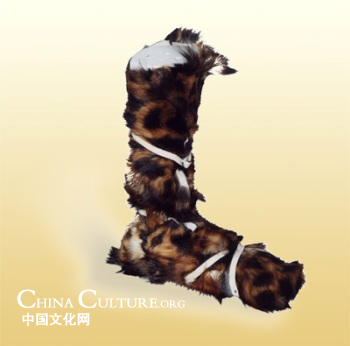
This is a copy of ancient Chinese shoes. Tens of thousands of years ago, ancient people had learned to use fur and plants to protect their feet from getting hurt, in particular fur left over from hunting. They were used as socks and shoes because of their durability and warmth. These were the first shoes by human beings.
|
|
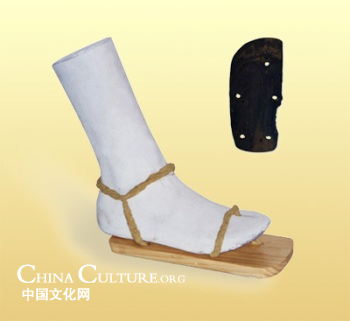
This picture shows a pair of ancient clogs. There are five holes in the board for wrapping cords. They were found in Zhejiang Province in 1989, in the Liangzhu Site from the New Stone Age. One clog had fallen apart and the other was whole when excavated. Through carbon dating, archaeologists determined that they had been made more than 5,000 years ago. Although this picture is just a copy, it still shows the design of the ancient clogs.