Chinese Alcohol, Chinese Spirits
Popular Huangjiu
Mijiu is the generic name for Chinese fermented rice wine, similar to Japanese sake. It is generally clear, and is used for both drinking and cooking. Mijiu intended for cooking often contains 1.5% salt. Alcohol content by volume: 12-19.5%.
|
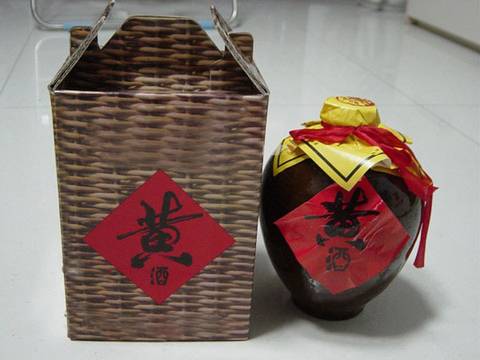 |
Fujian glutinous rice wine: made by adding a long list of expensive Chinese medicinal herbs to glutinous rice and a low alcohol distilled rice wine. The unique brewing technique uses another wine as raw material, instead of starting with water. The wine has an orange-red color. Alcohol content by volume: 18%.
Huadiao jiu, also known as nu'er hong: a type of huangjiu that originates from Shaoxing, in the eastern coastal province of Zhejiang. It is made from glutinous rice and wheat. This wine evolved from the Shaoxing tradition of burying nu'er hong underground when a daughter was born, and digging it up for the wedding banquet when the daughter was married. The containers would be decorated with bright colors so as to make a good wedding gift, and, to make the gift more appealing, people used pottery with flowery carvings and patterns. Huadiao jiu's alcohol content is 16% by volume.
Shaoxing wine is the internationally better-known high grade version of Huadiao jiu. It is commonly used in Chinese cooking as well as drinking. The reddish color of these wines is imparted by red yeast rice. It is not uncommon for some varieties of Shaoxing wine to be aged for 50 years or more.
Hong lu jiu is basically made of the same wine, except it is of lower grade than Shaoxing wine. It is named differently depending on its age, its container, and how it is used.
Liaojiu is a lower grade of huangjiu widely used in Chinese cuisine as a cooking wine. Often it is sold with various seasonings added.
Drinking Vessels
The splendid drinking vessels the Chinese made over the centuries enabled people to appreciate a few exquisite crafts and acquire tips on drinking along the trace of alcohol.
Like tea wares, drinking vessels have a long history as a part of Chinese alcoholic culture. Along the way, drinking sets witnessed the formation and development of it.
According to historical records and archeological discoveries, there were dozens of different kinds of vessels besides the cups we use today. The earthen wares archeologists discovered in Shaanxi province in 1983 were verified as the oldest drinking vessels ever uncovered.
During the Shang and Zhou dynasties, bronze vessels were popular in the north while porcelain vessels with carved figures debuted in the south. Vessels further developed between the Spring and Autumn period and the Warring States period, from pottery to porcelain with a thin coat of enamel.
Later, during the Qin and Han dynasties, glass vessels and whelk vessels appeared, and gold and silver cups adorned the banquets of the despots. Till the Northern and Southern dynasties, drinking vessels became more delicate and tasteful since intellectuals liked drinking that time. During the Sui dynasty and the Tang dynasty, porcelain pots and cups were common. Then after the Song dynasty, drinking vessels had a big family, consisting of porcelain vessel, bronze vessel, tin vessel, gold vessel, silver vessel, cloisonne vessel and rhinoceros horn vessel.
Chinese drinking vessels have won a lot of praise. Great poets like Li Bai, Wang Changling and Wang Han all wrote poems about liquor of taste and vessel of finesse.