Comments()
  Print
Print  Mail
Mail  Large Medium Small
 |
|
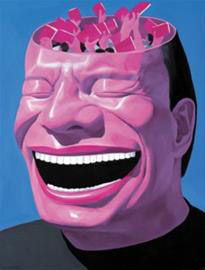
No. 4 Memory by Yue Minjun |
Modern Chinese portrait painting from the 1950s is explored in an exhibition by 76 artists including some of the biggest names in contemporary art.
Over the years portraits have sought to idealize subjects, to portray them realistically, to look into their hearts, to use them as symbols and to convey social messages.
Titled "Face," a major exhibition of contemporary Chinese portraiture is underway at the Minsheng Art Museum through May 20.
Works by 76 artists are displayed, including major figures Chen Danqing, Fang Lijun, Mao Yan, Liu Xiaodong and Zhang Xiaogang. Some works date from the 1950s and the "cultural revolution" (1966-1976) period.
"Portraiture is not just painting a person, but rather exploring how to draw a person and explore all the possibilities of his appearance," says Zhou Tiehai, executive director of the museum. "How to draw a person becomes much more important than what is painted, which is a critical turning point in contemporary portraiture."
According to Wang Min'an, a major art critic, realistic portrait dominated the mainstream until the 1980s. The milestone is Luo Zhongli's "Father" (1980).
"There were political code faces during the 'cultural revolution' and images are either sublime or ugly. They were all related to politics," Wang says.
Luo's "Father" broke the stereotype, portraying an ordinary old peasant with a deeply lined face, a very realistic, life-like and emotive picture.
But after the late 1980s, some young artists took aim at "Father" and similar works.
For example, Liu Xiaodong accentuated the texture by showing the wrinkles of the bodies; Fang Lijun exaggerated the features and faces to disorder the proportional relationship between the canvas and figures; Zhang Xiaogang processed the figures with geometric lines, making them appear like indifferent, rigid, dying figures without humanity.
"All of them gave up the principle of life-likeness and expressed the act of painting on the canvas," Wang says.
Whether the bald heads, weary expressions or impassive faces created by Fang, Zhang and Liu, Wang says they all signify the "immeasurable abyss of humanity.
"Even now these paintings are still considered realistic ones, no matter what attributes are added," he says.
Fang, Liu and Zhang dominated portrait painting in China in the 1990s.
"Perhaps this was the culmination of Chinese portraiture, but it was possibly the last one," museum director Zhou says. "Faces were barely seen in the portraits of the new century. The portraits still existed, but the faces lost their depth and profundity."
In his view, Chinese portraits today are merely symbols. Abandoning the aim of creating life-like images means that all the faces of the figures are distorted; the result is that figures appear bizarre, like illusions.
For example, the portraits painted by Mao Yan, Wang Yin and Wang Xingwei are neutral, akin to puppets without passion and desire. The figures are placed in surreal settings and the faces are decoded rather than encoded.
"The collapse of image is the so-called 'crisis of wall painting'," critic Wang says. "The fate of the portrait is the collapse of image, meaning the fading of the realistic portrait."
Today's portrait painting is decoded - the artist decodes psychological depth and recognition.
Since the 15th century, much of Western portrait painting has had the goal of letting viewers forget they are looking at a painting and feel instead that they are seeing a true living person on canvas.
The invention of the camera and digital technology changed the nature of portraiture.
"Renowned German critic Walter Benjamin once said, 'A painting has a unique glow that shines in the given object, which is an important difference from machine-copied objects'," says Zhou. "That might somewhat give the answer to the future of Chinese portrait painting."
That's also the glow that once shown from within portraits.



Copyright 1995 - 2010 . All rights reserved. The content (including but not limited to text, photo, multimedia information, etc) published in this site belongs to China Daily Information Co (CDIC). Without written authorization from CDIC, such content shall not be republished or used in any form. Note: Browsers with 1024*768 or higher resolution are suggested for this site.
License for publishing multimedia online 0108263 Registration Number: 20100000002731