

 Comments()
  Print
Print  Mail
Mail  Large Medium Small
 |
|
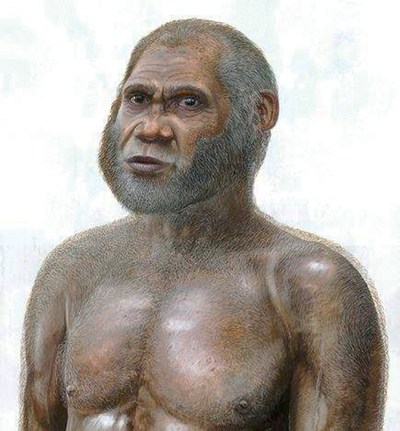
An artist's conception of a Red Deer Cave person. |
 |
|
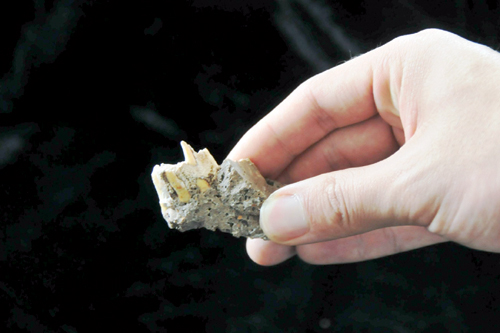
A fossilized tooth of a Red Deer Cave person unearthed from Maludong, Yunnan province. [Photo/Yan Niu/Xinhua] |
It has been almost a century since the Peking Man was first discovered. But curiosity still surrounds human origins.
The latest fossils unearthed are from Southwest China's Yunnan province. No lack of mystery and wonder surrounds them, as these cavemen had an extraordinary mix of primitive and modern anatomical features.
They could offer the answers to questions about the complexity of the migration and development of humans.
Named the Red Deer Cave People after one of the main sites they came from - Maludong, which literally means "Red Deer Cave" - the partial skulls and other bone fragments are between 14,300 and 11,500 years old.
The fossils were discovered in the 1970s and '80s but left unstudied. They came to light again after a recent rediscovery, which prompted deeper research by a team of scientists from China and Australia.
The team, led by professors Darren Curnoe of the University of New South Wales and Ji Xueping of the Yunnan Institute of Cultural Relics and Archeology, includes researchers from five Australian and six Chinese institutions.
What stunned the researchers were the cavemen's features, which are quite distinct from what you might call a fully modern human. "They look very different from all modern humans, whether alive today or in Africa 150,000 years ago," Curnoe says in an interview with the BBC.
Generally, they had rounded brain cases with prominent brow ridges. Their skull bones were quite thick. With short and flat faces tucked under their brains, these Stone Age individuals had broad noses and jutting jaws. What's particularly different from modern man is the lack of a modern human-like chin.
X-ray scans of their brain cavities indicate they had modern-looking frontal lobes but quite archaic-looking anterior or parietal lobes. They also had large molars.
Curnoe says one possibility is they were modern humans, who left Africa very early on and reached China but then did not genetically contribute to people alive in East Asia today.
The last decade has witnessed an explosion of scientific discoveries, which have radically rewritten our understanding of humankind's past. It is now known that all modern populations descend from a relatively small group that evolved in Africa around 160,000 years ago before spreading across the globe. As they did so, they encountered earlier populations of humans who descended from earlier migrations of pre-modern human ancestors out of Africa.
"The Red Deer Cave people could be an extinct human species. Their discovery proves to us the complexity of the evolution of humans in East Asia," Ji says. "The reason they also have traits of early Homo sapiens is perhaps because of the distinctive natural environment in Yunnan, which provided an isolated paradise and slowed the evolutionary pace."
Some experts do not believe Red Deer Cave people are a new species. "It is not rare to see fossils that carry both early and modern Homo sapien traits. In the same era, there were many human groups in China. Red Deer Cave people could just be ordinary Chinese," an anonymous paleoanthropologist in China told reporters.
In Maludong, scientists also found remnants of various mammals, many of which are still alive today. They also found the remains of an abundance of giant red deer. "They clearly had a taste for venison, and there is evidence they cooked these large deer in the cave," Ji says.
Tools were also unearthed, including shovels made from antlers, pyramids and stone hammers, hand hammers and quartz stone-cutting tools. This provided clear evidence they can be characterized as a late Paleolithic culture - hunters who lived in caves.
wangru@chinadaily.com.cn



Copyright 1995 - 2010 . All rights reserved. The content (including but not limited to text, photo, multimedia information, etc) published in this site belongs to China Daily Information Co (CDIC). Without written authorization from CDIC, such content shall not be republished or used in any form. Note: Browsers with 1024*768 or higher resolution are suggested for this site.
License for publishing multimedia online 0108263 Registration Number: 20100000002731