
 Comments()
  Print
Print  Mail
Mail  Large Medium Small
 |
|
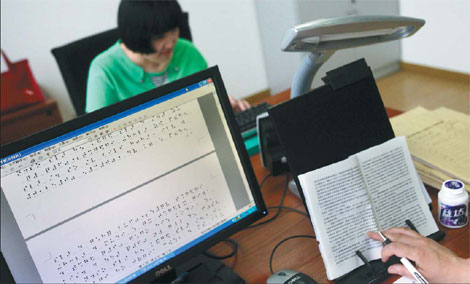
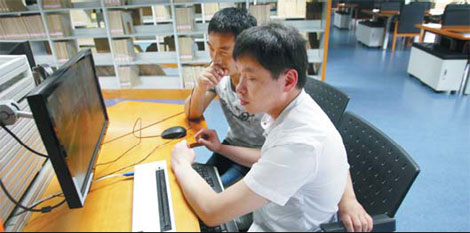
Two editors at China Braille Press proofread. Opened in 1953, it's the country's only publishing house serving the blind. Photos by Wang Jing / China Daily |
 |
|
Visitors to China Braille Library surf the Internet via a text-to-speech screen reader. |
Related: A blind woman's talent for words
A library for people with visual disabilities is rewriting the book on providing services for the blind. Wang Kaihao reports in Beijing.
Wang Xinmin rides the bus for more than an hour and a half to visit the only library he can use in Beijing - the China Braille Library, near the Temple of Heaven. The 50-year-old social worker with the Disabled Person's Federation of Chaoyang District visits at least once a week, despite the long commute. Wang lost his vision after a childhood eye injury. "It's hard for us to go anywhere far from home, but it's worth it, especially when I find some old people in the library, even though I can't see their faces. I don't have a clear impression of this colorful world."
The library used to be located in a half-century-old building without modern facilities in Beijing's western outskirts, near the Marco Polo Bridge, which was too far for Wang.
Librarian Wang Ying says things got better when the new library opened in 2011. It carries 60,000 books, most of which are published by China Braille Press, which is in the same building. It's the country's only publishing house serving the blind.
China Braille Press senior editor Huang Qiusheng says the publishing house, which opened in 1953, can only publish about 300 titles a year and hopes to release 800 this year, after moving into a different building and increasing its employees.
Huang still says this is far from enough. About 80 percent of China's Braille books are textbooks, and there are few literary works or books on traditional Chinese medicine.
But the librarian says about 90 percent of Chinese with visual disabilities can't read Braille. So, the library provides 20,000 hours of audio materials on its website.
Wang Xinmin rarely used the Internet before but now logs on more frequently, thanks to the library's text-to-speech screen reader.
"I mostly relied on the radio before," he recalls.
The library's computers also provide refreshable Braille display devices. A keyboard-like device renders Braille content as the cursor moves across the screen.
Library director He Chuan is in charge of developing the auxiliary software. He's also blind.
"Before, I had to ask others to read me books," he recalls.
"If I wanted to reread it, I'd have to make a recording."
One set of the software costs 700 yuan ($111). About 20,000 sets have been sold nationwide since it was developed 10 years ago. Fewer sets of the refreshable Braille software have been sold, because a set costs more than 10,000 yuan.
More than 16 million people live with visual disabilities nationwide, among whom, nearly 5 million are totally blind, Chinese Disabled Persons' Federation figures show.
"Many blind people suffer from poverty and can't afford the Internet, let alone the software," He says.
The Beijing municipal government bought about 5,000 sets in 2011 to provide to some blind people in the capital for free. The library also organizes training for users.
"But many more blind people outside Beijing don't have this privilege," He says.
He hopes for more sponsors. But money isn't his only woe. His team develops two updated versions every year but can't offer frequent online updates like some new software services.
Wang Ximin hasn't purchased a text-to-speech screen reader for home use. He points out it isn't compatible with some new software.
So, he uses it instead at the library, where he also enjoys listening to movie narrations, since he can't enjoy ordinary cinemas.
Wang also enjoys the weekend lectures on various topics, he says.
Zhang Jiliang, a blind Beijing-based writer, helps organize the lectures.
"The library isn't just a place for books," Zhang says.
"It's an open forum for blind people. Communication with more people will benefit those who often isolate themselves at home."
Zhang invites doctors, actors and artists to talk about speech, literature and medicine.
He says some blind people will ride the bus for hours from remote suburbs to attend. Wang Xinmin is a regular.
"I never had a chance to get in touch with so many celebrated people and hear them discuss their fields," Wang says.
"And it's more than just knowledge. It creates a comfortable atmosphere for us. We don't get to enjoy many such occasions."
He says he regrets not inviting so many blind people from his neighborhood.
"Although discrimination against blind people has largely decreased in society, they still must work harder than people without visual disabilities to make good impressions on their employers," he explains.
"So, they're usually afraid to ask for leave to attend cultural events, which fulfils a need for them."
Wang is considering organizing lectures in his community.
"We can achieve a lot," Wang says.
"But we need society to put more focus on us."



Copyright 1995 - 2010 . All rights reserved. The content (including but not limited to text, photo, multimedia information, etc) published in this site belongs to China Daily Information Co (CDIC). Without written authorization from CDIC, such content shall not be republished or used in any form. Note: Browsers with 1024*768 or higher resolution are suggested for this site.
License for publishing multimedia online 0108263 Registration Number: 20100000002731