Comments()
  Print
Print  Mail
Mail  Large Medium Small
 |
|
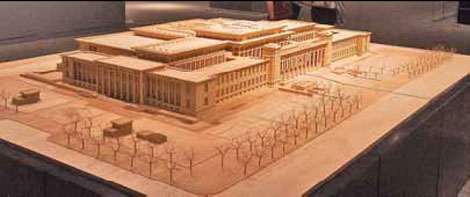
A miniature of the National Museum of China is displayed in the museum's architectural exhibition. Zhu Linyong / China Daily |
March 2011's trial opening after the National Museum of China's large-scale renovation and expansion captivated the public.
"It's a new icon and major destination for visitors to the country's capital," museum director Lu Zhangshen said at the opening.
That's apparently so much so that an architectural exhibition opened last week to show how the new museum was constructed.
The four-part show is part of the museum's centenary celebrations. It displays the museum's history, old buildings, shortlisted plans for the museum's renovation and expansion, a revised edition of the bid-winning plan and the final plan that was implemented.
"Viewers will see the making of a new museum and how the older parts organically adjoin the newly constructed expansion," Lu says.
The museum's history dates back to July 9, 1912, when the Kuomintang government formulated a blueprint for the National Peking Museum of History, Lu says.
But it wasn't built until 1959 and in a different form.
Mao Zedong decided at a 1958 Politburo meeting in Hebei province to build the museum in its current location.
Some experts, including Lu, believe the museum was located east of Tian'anmen Square to mirror the Great Hall of the People to the west.
Traditional beliefs hold the left side should be reserved for ancestors, while the right side is for ceremonial activities concerned with State and foreign affairs.
It was among the icons constructed when the Soviet Union exerted great influence in China, which extended into the realms of art and architecture.
The old buildings actually housed two museums constructed at the same time - the National Museum of Chinese History and the National Museum of Chinese Revolutionary History.
The national museum, Great Hall of the People, Military Museum and Agricultural Exhibition Center were all built to commemorate the 10th anniversary of New China's founding.
Building materials were brought in from around the country, and architects and engineers from the Soviet Union were involved.
The completed structures were hailed as landmark achievements of socialist society and were among Beijing's "top 10 monumental buildings".
The two museums merged into the National Museum of China in 2003.
The recent expansion was an answer to calls to better present the country's history, civilization and rejuvenation over the past century as the country rises. The museum began soliciting bids for plans from international architects in 2004. Ten projects were shortlisted.
Approval was given to a plan by the Institute of Building Design under the Chinese Academy of Building Research and the German design company Gerkan, Marg and Partners.
The plan underwent rounds of feasibility research and discussions, involving the country's top experts in various fields.
"There were inevitable arguments and differences among experts, officials and foreign architects," Lu recalls.
For instance, the German company proposed covering the existing building's courtyard with a floating bronze roof to create an interior public square. But that idea was nixed.
"Our exchange appeared to be openhearted and direct," Gerkan, Marg and Partners architect Stephan Schuetz says.
"Different cultural backgrounds generate different views on the same subject. But we all felt it was not an obstacle to this project."
Schuetz - along with Meinhard von Gerkan and Stephan Rewolle - played a key role in revising the bid-winning design.
"The biggest challenge was to create a dialogue between the old building from 1959 and the extension project, which finally tripled the original floor area," Schuetz says.
"The tremendous importance of the existing building became clear to us through discussions with experts and architects."
Most Chinese experts suggested creating a more harmonious interaction between the existing building and the extension.
"That was the reason we were asked to revise the design," he recalls.
The final implementation plans were confirmed by the State Council in 2006.
The 2.5 billion yuan ($393 million) renovation and expansion started on March 17, 2007, and finished before the end of 2010.
On March 1, 2011, the new museum began a yearlong trial operation. It covers nearly 200,000 square meters and houses more than 1.2 million cultural relics and artworks. The museum contains 48 large exhibition halls, a theater, a conference hall and a live broadcasting studio.
It has received more than 4.1 million visitors in the past year. During that time, it has staged more than 50 large-scale exhibitions, and organized academic seminars and symposiums on arts and cultural heritage.
"The new museum has won accolades from visitors and experts," Lu says. "It's also a monumental structure that symbolizes an upgrade in China's soft power."
zhulinyong@chinadaily.com.cn



Copyright 1995 - 2010 . All rights reserved. The content (including but not limited to text, photo, multimedia information, etc) published in this site belongs to China Daily Information Co (CDIC). Without written authorization from CDIC, such content shall not be republished or used in any form. Note: Browsers with 1024*768 or higher resolution are suggested for this site.
License for publishing multimedia online 0108263 Registration Number: 20100000002731