
 Comments()
  Print
Print  Mail
Mail  Large Medium Small
Related: Emperor's Secret Garden, Perfection is part of the process, Zooming in on a place of mystery
Experts are exploring and restoring the Forbidden City's best-preserved, yet least-understood, structure - Emperor Qianlong's long-sealed retirement lodge. Zhang Zixuan reports in Beijing.
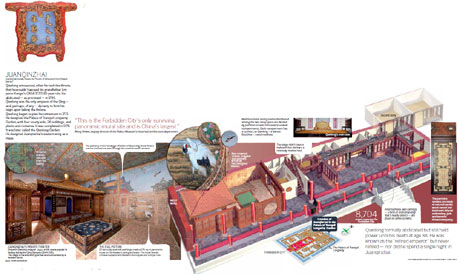
Juanqinzhai is considered the Forbidden City's most exquisite and mysterious structure. And, because it was sealed off for much of a century, it remains one of the compound's best-preserved - yet least-understood - buildings. Juanqinzhai, which translates as the "Studio of Exhaustion from Diligent Service", was built as the retirement lodge of Qing Dynasty (1644-1911) Emperor Qianlong (1711-99) - who never actually retired. Still, he was the only emperor to, upon ascending to the throne, set a time limit before he would step down, so he wouldn't exceed the 61-year rule of his grandfather, Kangxi. While he technically abdicated in the 60th year of his reign, he continued to wield power until his death. "Qianlong was passionate about art and obsessed with southern China," says Wang Shiwei, deputy director and senior engineer of the Palace Museum's historical architecture department. "He had many dreams he wanted to realize. These are reflected in the styles, arrangements and decorations of the Qianlong Garden (around Juanqinzhai)." But while Qianlong never lived in the lodge built for him, he went there a lot for leisure, so did later emperors, until the Qing's - and China's - last ruler Aisin-Gioro Puyi (1906-67) was expelled from the Palace in 1924.
Juanqinzhai was sealed up ever since.
"Because it was closed off for so long, it remains the least-damaged and least-changed part of the Forbidden City," Wang explains.
"But the lodge was still in need of repair after 200 years. It was time to wake it up."
The Palace Museum signed a $3 million agreement with the World Monuments Fund (WMF) in 2003 to complete the repairs.
Palace Museum curator Shan Jixiang says it's the Palace Museum's first large-scale interior design restoration and its first major international partnership. WMF China representative Liu Chang says the project is also the foundation's largest.
Shan says: "Juanqinzhai stands out among the Forbidden City's 8,704 rooms for its luxurious and personalized style, which shows the pinnacle of Chinese interior design and Qianlong's inner world."
Wang points out: "Juanqinzhai's exterior is quite simple, but its interior is unrivaled."
The most dazzling decorations are the 170 square meters of paint-on-silk panoramic murals that cover the ceiling and walls of the lodge's theater.
More than 20 works of various sizes infuse Chinese materials and subjects with Western techniques of perspective and trompe l'oeil, which was introduced by Italian artist and missionary Giuseppe Castiglione (1688-1766), who served as Qianlong's court painter until the artist's death.
The panoramic murals are believed to have been created by Castiglione's student Wang Youxue.
The northern wall is adorned with red-crowned cranes, magpies and peonies - all auspicious symbols.
The painting of the Fuwangge (Pavilion of Expecting Good Omens) mirrors the actual pavilion seen through the southern wall's window.
"This is the Forbidden City's only surviving panoramic mural site and is China's largest," Wang says.
The theater contains a gold-leaf-covered indoor pavilion that serves as a stage with wooden railing.
Partition screens divide five rooms on the two-story area on the rectangular building's eastern side into uneven compartments, each with a cot so Qianlong could sit to meditate.
"Qianlong was creative in using such limited space in interesting ways," Wang says.
The partitions are made of red sandalwood carved and inlaid with bifacial embroidery, jade and bamboo thread marquetry. Many also feature inner bamboo-skin carvings created using a form of craftsmanship that's virtually dead today.
Wang, who led the project, says the structure was sound.
"Everything inside was in place but in a precarious state," he says.
Some materials had aged better than others.
The screens were mostly intact. But much of the inlaid jade and bamboo threads had fallen off, as the glue lost efficacy. The centuries had claimed most of the bifacial embroideries.
The repair team scoured several southern provinces to find inheritors of these nearly - or completely - dead forms of craftsmanship.
Another challenge was posed by the murals, which were damaged by worms, stains and fading.
The painting and calligraphy mounting section of the Palace Museum's Cultural Relics Protection and Technology Department teamed up with the WMF to revitalize the paintings.
"We took down all the pieces, repaired them and seamlessly pasted them back on the ceiling and walls without affecting the indoor stage or other displays," the section's associate researcher Yang Zehua says.
"It was one of the most challenging tasks we've ever done. I believe it's unique in the world."
In 2006, the project's success prompted expanded cooperation between the Palace Museum and the WMF to rejuvenate the Palace of Tranquil Longevity Garden, which Qianlong designed with four courtyards, 24 buildings, and plants and rockeries. The project is slated for completion in 2019.
"Every building in the Qianlong Garden has a different structure and interior design," Wang says.
"The historic interpretation and research of Juanqinzhai can't be separated from the rest of the garden."
"The ways architecture, interior design and displays connect to imperial culture can be seen here."
He expects the repair of the edifices, which are inlaid with enamel, porcelain, mother-of-pearl and painted glass, will bring a host of surprises.
Fuwangge, for instance, contains a unique type of chiffon that features complicated patterns created with gold leaf and embossed painting techniques not found anywhere else in the Forbidden City. The methods for creating these patterns are a total mystery.
The repairs will be documented visually and in 3D to enable before-and-after comparisons. And the museum is creating an online 3D model.
While work is under way on the garden, the final details of Juanqinzhai are still being restored, even though the major work ended in 2008.
Wang says his team is experimenting with methods to reinforce, without destroying, the fragile embroidery.
Juanqinzhai is currently sealed and fitted with an air-circulation system that controls temperature and humidity. The number of experts who visit is also limited.
Plans for opening it to the public are still in the works.
"Through advanced technology, I believe Juanqinzhai's restored interior can last at least another 200 years," Wang says.
Contact the writer at zhangzixuan@chinadaily.com.cn.



Copyright 1995 - 2010 . All rights reserved. The content (including but not limited to text, photo, multimedia information, etc) published in this site belongs to China Daily Information Co (CDIC). Without written authorization from CDIC, such content shall not be republished or used in any form. Note: Browsers with 1024*768 or higher resolution are suggested for this site.
License for publishing multimedia online 0108263 Registration Number: 20100000002731