Comments()
  Print
Print  Mail
Mail  Large Medium Small
 |
|
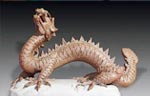
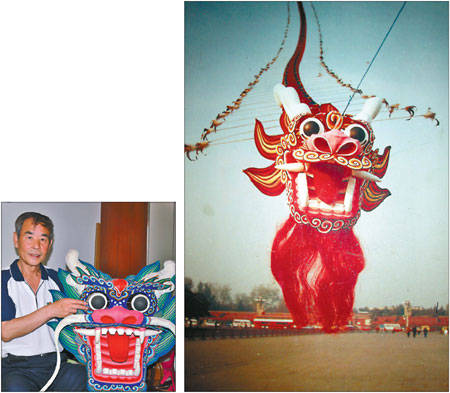
Kite designer Hao Deli (left), and his works: the huge Beijing-style dragon kite and all types of traditional kites (cover photos and below). Photo by Liu Xiangrui or Provided to China Daily |
Related: High Flyers, Timeline
They come in all shapes, sizes and colors, and they had all gathered for an exhibition in Beijing. Liu Xiangrui marvels at the kite makers and their devotion to a traditional craft.
It was all there - from a huge dragon kite 100 meters long to tiny ones about the size of a name card. There were classic swallow-tailed kites to luminous modern inventions made from carbon fiber. And, they were all set to fly, each and every one a masterpiece.
The recent exhibition jointly organized by the Beijing Folk Literature and Art Association, Beijing Kites Association, and the Solana Lifestyle Shopping Park in Beijing was a real treat for the passionate followings that gathered.
They were proof that kite making and flying, with a long history and rich culture, have never faded from the Chinese people's life. Kites still claim a unique hold on many as a popular outdoor hobby.
China has pushed hard to preserve its traditional, cultural heritage and the kites, past and present, have been included as part of the nation's intangible cultural heritage, according to Yu Zhihai, the deputy chairman of the Beijing Folk Literature and Art Association.
"Society's demand for traditional arts is increasing, which has helped their preservation," Yu says. "We need folk arts which bear unique national traits to keep our balance in an increasingly globalized world."
Kites were first used as military signals in China about 2,800 years ago and became an outdoor hobby in the Song Dynasty (960-1279).
Classic kites use bamboo for spars and paper for sails. They developed into many different shapes and forms, which often convey specific messages related to happiness, longevity and good luck.
They also gained distinctive features in different parts of China.
Beijing, which has six centuries of history in the art, is regarded as one of China's four major kite-production centers, renowned for its graceful and exquisite kites.
Hao Deli, who demonstrated his craft before a crowd of kite lovers at the exhibition, is noted for his Beijing-style dragon kites which are often huge, always elegant and vividly painted.
Unlike many craftsmen whose skills were passed down through generations, Hao is self-taught.
"But I have my own advantages," says the 68-year-old retiree. "I have a good sense of three-dimensional space, and so I already have the kite in my mind before it's there."
The long-time designer of machine tools says his "occupational habit of going for accuracy was a plus for the meticulous work".
Hao makes all types of traditional kites, but favors dragons.
"The dragon is a Chinese totem," he says. "Getting huge dragon kites to fly is a sensational feat for both the player and his audience."
In the past, dragon kites were the exclusive toys of the imperial family, and commoners were relegated to centipede-shaped kites.
Hao spent days studying the only Beijing-style dragon kite, which was kept in the Palace Museum, and carefully noted its complicated traditional mechanics and design before he finally produced his copies.
His creations have won numerous awards and his favorite pastime was to amaze crowds gathered at Tian'anmen Square with his huge dragon kites.
Open fields are best for kite flying, he says, but the urban sprawl has reduced the number of suitable spaces. There are just too many skyscrapers and cars around.
While Hao strives to revive and improve traditional techniques, Ha Yiqi, another celebrated Beijing-based kite artist, represents the new as he introduces modern technology into an old craft.
Kites produced by Ha's family have a history of 160 years and are known for their delicate art and exquisite moldings. The kites are eagerly sought after by collectors.
Ha, now 58, started learning from his father when he was 10. He still remembers his early attempts at innovation.
His father had chided him for using a square frame when it should be round, and he had replied: "I want to be different."
"Of course we can't abandon the traditional techniques. But if we dwell on past achievements instead of keeping up with modern tastes and trends, Ha's kites may die in my hands."
After he saw a geometric kite bigger than a room on an overseas trip, Ha was impressed enough to attempt one when he returned home.
He also started using his training in Western art and made bold updates with traditional kite painting techniques. He introduced geometrical patterns, gradient shades, blue-and-white porcelain paintings, batiks and many Western artistic elements into his kites.
He was also the first to use glass frames for his kites.
All his experiments have made him well-known both at home and abroad. Besides collecting international awards regularly, he also holds exhibitions of his kites.
Eager to share his knowledge and actively exchanges ideas with fellow kite makers, and his apprentices, Ha has published a book on his craft. The Ha family kites were listed as a national intangible cultural heritage in 2003.
Contact the writer atliuxiangrui@chinadaily.com.cn.



Copyright 1995 - 2010 . All rights reserved. The content (including but not limited to text, photo, multimedia information, etc) published in this site belongs to China Daily Information Co (CDIC). Without written authorization from CDIC, such content shall not be republished or used in any form. Note: Browsers with 1024*768 or higher resolution are suggested for this site.
License for publishing multimedia online 0108263 Registration Number: 20100000002731