
 Comments()
  Print
Print  Mail
Mail  Large Medium Small
Related: Making friends and influencing German people
Carsten Krause, 40, the director of the Confucius Institute at the University of Hamburg in Germany, is more than happy to renew his five-year contract with the institute.
"Promoting cultural communication is an interesting job," says Krause in fluent Chinese. "The Confucius Institute is more like my kid, a 5-year-old who has started kindergarten but doesn't need breastfeeding anymore," he adds.
Krause graduated from the Department of Chinese Language and Culture, at the University of Hamburg, with a PhD, in 2001.
In 2004, the Chinese government established Confucius Institutes to promote Chinese language and culture abroad. These institutes are nonprofit organizations attached to foreign academic institutions such as universities.
In April 2012, there were 129 Confucius Institutes and 104 Confucius Classrooms in Europe.
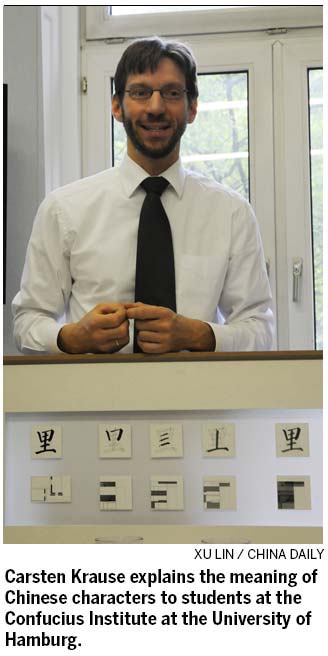
In 2007, the University of Hamburg and Fudan University from Shanghai co-established the Confucius Institute. Krause spent about six months laying the foundations for the institute and became the director. Currently, it has 15 teachers and three volunteers.
As one of the most important Chinese training centers in the city, the center has three semesters a year, attracting about 120-150 students per semester.
About half of them are office workers, including those who travel to China for work. Nearly one fourth are middle school and university students. The center conducts four 90-minute classes per week, and each class costs $8 per student.
In addition to the classes, there are weekend activities such as a "Sino-German dialogue", where Chinese and German experts in the fields including science, arts and history, give talks.
According to Krause, the institute has close partnerships with more than 20 teaching research centers as well as media and government departments in Hamburg. For example, they often cooperate with the city's theaters and cinemas to invite famous Chinese artists to perform, such as The National Ballet of China.
He says the institute has gained popularity in the city. The local government has been supportive and in 2011, invited them to join the mayor's delegation to visit China.
Krause used to work in the general office of the Hamburg government and was in charge of Sino-German cooperation. He took the University of Hamburg's invitation to join the institute immediately because he had just ended his tenure in the government and was job hunting.
"In my previous office, all my colleagues were Germans. I so much wanted to have a Chinese colleague, so that I could ask him or her questions about Chinese language and things about China. At the Confucius Institute, I've realized my dream, to work with people from both countries," he says.
The Confucius Institute headquarter, or Hanban (Chinese National Office for Teaching Chinese as a Foreign Language), regulates that both Chinese and foreign parties invest equally in the Confucius Institute.
While Hanban provides the funds, a Chinese director and volunteers, the foreign university offers office space, equipment and a foreign director. Both directors co-direct the institute.
"Krause and I complement each other perfectly," says Chinese director Geng Baosheng from Fudan University. "We often host culture activities together. It's our task to let more foreigners learn about the real China, as many Germans only read about China from the media."
"I like the institute's unique way of governing, where there is cooperation between two directors. Geng and I have become best friends," Krause says. He says he shares responsibilities with Geng, but there's no clear line of duties. They use their expertise, do their best and go with the flow.
For example, Geng, an associate professor with Fudan's Art Center, has groomed many of his students in Hamburg to win prizes in "Chinese Bridge" - a Chinese Proficiency Competition for Foreign College Students organized by Hanban.
"I can't do that. Instead, I shoulder more responsibilities in terms of financial affairs, because I'm more familiar with German laws," Krause says.
His interest in the Chinese language grew when he went to a middle school in Shanghai for a brief exchange program in 1988. Later, as a law student, he was in Jiangsu province's Nanjing University for a one-year exchange program. The stint changed the direction of his life - he switched major from law to Chinese studies when he returned to Germany in 1994.
Hamburg Mayor Erster Burgermeister says, "Krause has done a good job. Young Hamburg people have become more interested in China. I'm proud of the Goethe Institute, as well as Hamburg's Confucius Institute, which help our citizens learn more about Chinese language and culture."
xulin@chinadaily.com.cn



Copyright 1995 - 2010 . All rights reserved. The content (including but not limited to text, photo, multimedia information, etc) published in this site belongs to China Daily Information Co (CDIC). Without written authorization from CDIC, such content shall not be republished or used in any form. Note: Browsers with 1024*768 or higher resolution are suggested for this site.
License for publishing multimedia online 0108263 Registration Number: 20100000002731