Comments()
  Print
Print  Mail
Mail  Large Medium Small
 |
|
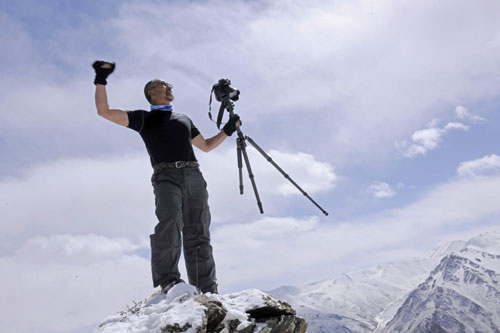
Highland photographer Li Guoping stands on top of a snow mountain. Photos provided to China Daily |
 |
|
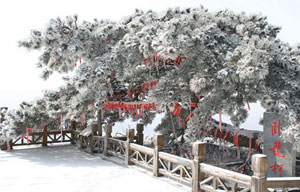
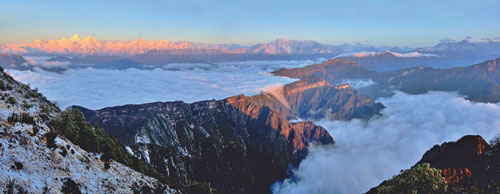
A picture by Li Guoping features a view of Niubei Mountains in Ya'an, Sichuan province, at sunrise. |
 |
|
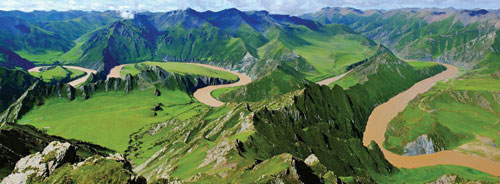
Li captures a panoramic view upstream of the Yangtze River. |
For the images that he has grown famous for, explorer-photographer Li Guoping has paid a very visible price. Zhang Kun coaxes the story of his experiences out of the limelight-shy adventurer.
Explorers are like veteran soldiers. They wear their scars with pride, like badges of honor. Li Guoping had to walk through a mist- obscured ditch on his way to the town of Chentang, where no more than 100 to 200 Sherpa households lived on the mountains by the China and Nepal border.
When Li and his colleagues finally climbed out of the valley in the heavy fog, they were terrified to find leeches crawling all over them, feasting on blood and leaving bleeding wounds when they were pulled off.
They hardly had time to reflect on the experience, because on the same night, as they sought shelter in a local household for rest, vicious ticks left poisonous bites which took months to heal.
Related: Lomography: a mix of vintage and chic
For that trip alone, Li ended up with dozens of scars on both arms. They are very obvious on his well-tanned skin, but for him, they have the unexpected advantage of becoming conversation starters.
"I work in the wildness, and sometimes I'm not too good at talking to people," Li says.
Another time, he tripped on loose gravel and slid quickly towards the cliff edge. He had thought: "This time I am dying for sure" until he was stopped by a rock. He had once seen a mountain goat fall off and land dead at his feet, and he had realized then "it could happen to me!"
Li is in very good physical shape from all that outdoor activity, but indoors, he wears a baseball cap to hide his awkwardness. Li, 54, is a highland photographer and explorer.
His photographs of snow-capped mountains, glaciers and the uninhabited wilderness are often published in China National Geographic, the country's most highly acclaimed natural science journal.
Next month, the public can see some of these visuals in Shanghai at the Liu Haisu Art Museum from Sep 25 to Oct 7, in a solo exhibition sponsored by Huaxia Bank. More than a hundred of Li's best photographs of China's Wild West will be on display.
"Li has been our long-time project photographer - his photographs of China's glaciers are especially rare, as no one else has taken them before," Sun Yibo, an editor with China National Geographic, says.
"Many photographers set up their cameras at famous scenic spots, rows of them lining up, waiting for sunrise, or sunset or any slight change of light. They can be found on Mount Huangshan, Lushan, or Emeishan, gathered like journalists fighting for an exclusive.
"Li never has to worry about this kind of competition. Where he goes, no matter how the light or clouds change, he's always the only one with the camera. He climbs too high to have anyone else follow after him." This was how Shan Zhiqiang, executive editor-in-chief of China National Geographic, described Li's photographs used in his magazine.
The photographer has all the prerequisites for his job - fitness, vision and photographic skills. All these combine to allow him to "climb up there, see it, and capture it with his camera", says Sun.
Li admits he was never professionally trained, and explains his success with a simple sentence. "Because I'm never afraid of taking risks."
His career as a photographer did not start until 2005, and he was working in a chemical plant monitoring instruments for 14 years before returning to his hometown of Chengdu in Sichuan province to join a foreign trading company.
Li had always been keen on a variety of hobbies, including Chinese calligraphy and volleyball. He also had a talent for innovation, and he is a self-taught electronics engineer. One of his inventions, a computerized chess contest management program, has been used in national championship contests.
Because of his work with the foreign trading company, he used to travel frequently to the mountain regions of Sichuan to source wild mushrooms for export to Japan and Europe. He became so familiar with the area that he was often retained as a guide for international explorers and Chinese scientists for expeditions.
Gradually, his footprints expanded and soon he added more mountains, deserts and uninhabited wilderness to his scope.
His first photos were taken with a salvaged camera with a back flap that had to be tied in place with rubber bands.
"I used to spend a lot more time fixing the camera, or getting it ready to work, than taking pictures," he says. But the camera served him well.
At Tingri county in the Tibet autonomous region, he managed to take a panoramic picture spanning five snow-topped mountains higher than 8,000 meters. In Yushu in Qinghai province, he captured six magnificent curves upstream of the Yangtze River.
"I could hardly believe my eyes when the curves showed up - I had only seen them on Google Maps," Li says. "I guess you could have the pictures taken from a helicopter, but to me, that feels a little like cheating. It's different when you stand there after days of hard climbing, and record what you see with a camera."

Very often, he deals with the hardships all by himself. He will spend hours digging under the wheels when his car gets stuck in ditches, and will wade through icy rivers to save a few extra hours by road. When wild animals like wolves and bears show up, Li's first instinct is to run towards them for a closer look, instead of running away like many travelers. But interestingly enough, the animals often run away from him.
There have been misadventures as well. Once he was so eager to go forward that he unknowingly crossed the boundary between China and India. He was told later that patrolling troops on either side could have shot him.
"Old bloke, you don't want to lose your life, do you?" the officers had asked him.
"People my age should be playing mahjong, drinking a little perhaps, or taking care of their grandchildren," he says. "But I find my current lifestyle more rewarding."
Contact the writer at zhangkun@chinadaily.com.cn.



Copyright 1995 - 2010 . All rights reserved. The content (including but not limited to text, photo, multimedia information, etc) published in this site belongs to China Daily Information Co (CDIC). Without written authorization from CDIC, such content shall not be republished or used in any form. Note: Browsers with 1024*768 or higher resolution are suggested for this site.
License for publishing multimedia online 0108263 Registration Number: 20100000002731