
 Comments()
  Print
Print  Mail
Mail  Large Medium Small
 |
|
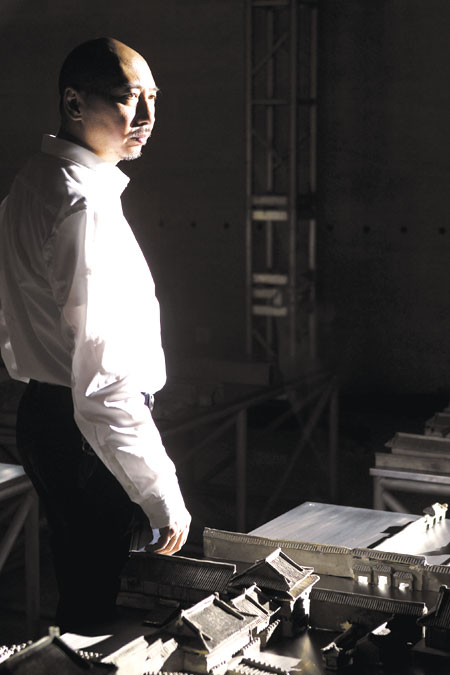
Li Xiangqun with his work Grand Forbidden City. Jiang Dong / China Daily |
Li Xiangqun's first solo show in his 34 years of career ran for only four days at the National Art Museum of China. And it presented only a handful of sculptures.
Despite that, the exhibition drew public attention and critical acclaim.
"Li is a unique case in the contemporary art scene," curator Zhu Qingsheng says. "His art successfully crosses in the traditional and the vanguard. It easily takes viewers on an inner journey back in history."
But Li says the exhibition is not a retrospective show of his artistic career.

"It is but a periodic summary of my latest explorations and experiments," the 51-year-old explains.
Among his masterpieces are a life-size statue of Confucius; a pair of white copper reliefs resembling a hanging-scroll ink painting titled The Sovereignty; a group of portraits of Mao Zedong; a pair of portraits of Qing Dynasty (1644-1911) Empress Dowager Cixi titled Heaping Clouds and Snow; and a 300-sq-m copper installation titled Grand Forbidden City.
Li is considered a rare, red-hot sculptor among collectors. In 2010 and 2011, his works managed to rake in millions at auctions in Beijing. Among his fans are former International Olympic Committee chairman Antonio Samaranch and American business magnate George Soros.
His artistic creations cover myriad themes, including rural women, soldiers, literary giants and central government leaders.
Li has been widely viewed as the most influential living sculptor, who has created the most "red sculptures" (key figures in China's modern history or former Communist leaders) over the past decades. Some critics call him a figurative sculptor of modern Chinese history and revolution, who clings to traditional modes of creation.
But Li brushes off the label.
"Observant viewers can see from the details that I am making every effort to go further in my art," Li says.
For example, the first exhibit titled The Walking Man is presumably a portrayal of Confucius but keeps audiences confused.
Bearing a blank face, the sculpture is tall and slender, with long and feminine fingers. Its clothes have a mixture of ancient and fashionable elements. And there is a pillow near its feet.
"Confucius and his ideas have been subjected to various interpretations by generations of scholars and rulers. I leave room for viewers to imagine what Confucius is like," Li says.
People often elevate historical and political figures like gods, Li says, and that is a problem.
"All my works on show are demystifying. I am trying to humanize the characters," the artist says.
One of Li's most controversial works that portrayed such an idea is Heaping Clouds and Snow, which he created in 2006. It is a portrayal of a half-naked Dowager Empress Cixi, one of the most powerful and controversial female figures in Chinese history.
Li says he is happy that no one questioned his current work. "The public is becoming more open-minded and tolerant of fine art experiments," Li says. "On the surface, my works are about history and politics, but they are actually all about human nature and love."
Li has prepared a series of Mao Zedong's portraits as the centerpieces. He opines that to understand Chinese history and China today, "one has to understand Mao and his impact on people and society".
Unlike most of his contemporaries, who choose to depict Mao in a more or less negative way, Li has portrayed the former Chinese leader in a positive and humanistic light.
Li says that he decided to explore the subject of Mao Zedong after he read Edgar Snow's book Red Star over China in the 1980s. He was deeply moved by Mao's story and decided to tackle the subject as a long-term mission.
"When we talk about Mao - his merits and mistakes alike - we cannot look only at Mao himself while ignoring the fact that all individuals of the Mao era had played their own part in it," Li says.
Although some of Li's family members and relatives suffered during the political upheavals in the Mao era, he says: "I have never had any hatred toward Mao. Instead, deep in my heart, I feel a kind of father-and-son affection."
Another eye-catching showpiece is Grand Forbidden City, which took Li six years to conceive and materialize.
Instead of a conventional, colored-copper miniature of the Ming (1368-1644) and Qing dynasties' royal compound, Li has divided the palace grounds into several parts and displayed them on iron tables, complete with random visitors and scaffoldings to give a sense of reality.
Li has also dropped the initial idea of creating a brightly colored Forbidden City and instead created one with a depressing gray color.
"I hope my brief and minimalist solo show prompts visitors to rethink our history and social reality. And I will continue to do so in the coming years," Li says.
zhulinyong@chinadaily.com.cn



Copyright 1995 - 2010 . All rights reserved. The content (including but not limited to text, photo, multimedia information, etc) published in this site belongs to China Daily Information Co (CDIC). Without written authorization from CDIC, such content shall not be republished or used in any form. Note: Browsers with 1024*768 or higher resolution are suggested for this site.
License for publishing multimedia online 0108263 Registration Number: 20100000002731