Comments()
  Print
Print  Mail
Mail  Large Medium Small
 |
|
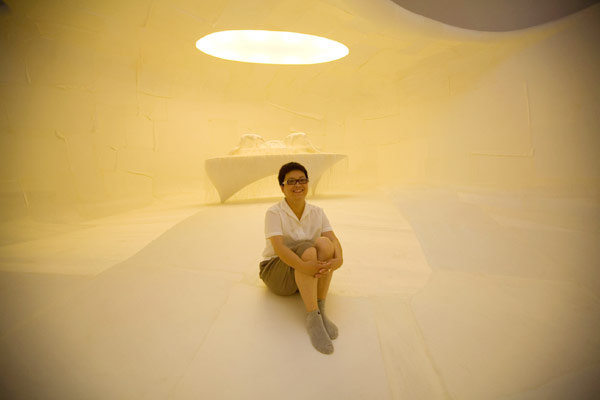
Lin Tianmiao appears at Bound and Unbound exhibition held in New?York. Photo provided to China Daily. |
 |
|
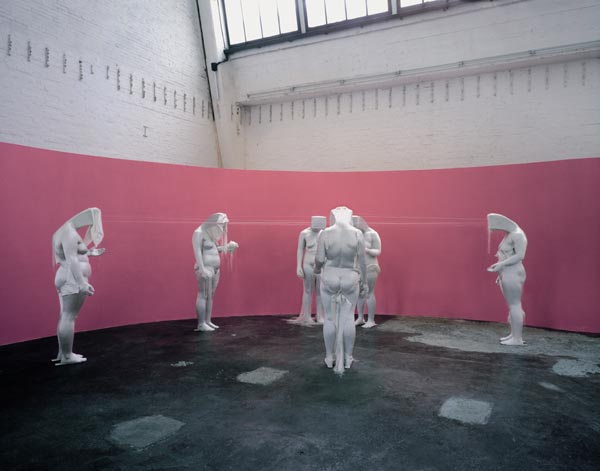
Chatting, an installation by Lin Tianmiao in 2004. Provided to China Daily |
After eight years in New York City, artist Lin Tianmiao returned to Beijing in 1995 and settled into domestic life.
Surrounded by the trappings of motherhood and a home that felt new again, Lin, then in her mid-30s, wrapped string around household objects in what would become her signature technique. The result was her first major work, The Proliferation of Thread Winding, which launched her career. Today she's one of a few female Chinese artists with international name recognition.
This fall Lin returns to New York as the subject of the Asia Society's Bound and Unbound exhibit (open through January 2013), her first big solo showing in the United States. In 1998, she was part of the society's Inside Out New Chinese Art, a survey of contemporary Chinese works including those of avant-garde artists. Lin also has had exhibits at the Museum of Modern Art and the Brooklyn Museum.
In installations such as Bound and Unbound (1997), for which the current show is titled, Lin's thread-winding is applied to nearly 800 objects?- kitchen utensils, cooking pots, kettles and so on. An accompanying film depicts a pair of scissors chopping at hanging threads.
"I have used thread in my work from the very beginning," the artist says. "It became one of my habits. I find that its linear expression is very dynamic, so I have continued to use and did not abandon the technique."
The technique itself is a statement, says Melissa Chiu, director of the Asia Society Museum and the exhibit's curator.
"The physical act of thread-winding is incredibly monotonous," Chiu says. "And yet it creates something beautiful. She works with what is around her to create something truly new."
Although much of Lin's work centers on women's issues, the artist doesn't necessarily identify as a feminist, Chiu says.
"Very few female Chinese artists would identify themselves that way," she says. "And yet, she is one of a couple of female artists in China who have had sustained art practice. She is clearly interested in women's issues and has led the way in her field. But I don't think she would identify specifically as a feminist."
In 2004's Chatting, six female bodies?- fleshy and in the shape of middle-aged women?- feature flat screens for faces. The figures emit noise, creating a dissonant mix of gossipy laughter, grunts and the sounds of weeping. The piece explores the "decay" of the body, a theme that runs through the exhibition.
In All the Same (2011), a rainbow of colored thread is wrapped around 180 synthetic approximations of human skeletal bones, which Lin has called "the only perfect object left in the world".
"Bones do not have the difference of hierarchy, culture, classes, politics and social property between them," she writes in the exhibition's accompanying text.
"I use them causally to transform, continue or reconnect with my artistic imagination. They are also another way that I incorporate my body into my art." More or Less the Same (2011) also features synthetic human bones, paired with tools and all wrapped in silver thread.
Lin was born in 1961 in Taiyuan, Shanxi province, to artist parents. In fact, she credits her initial fixation on thread to early memories of helping her mother sew clothing,
She is married to video artist Wang Gongxin, with whom she collaborated on Here? Or There?, an installation commissioned by the Shanghai Biennale in 2002 and also on display at the Asia Society. The piece features a mix of human figures and video, depicting quiet countryside locales jarringly interrupted by the noise of urban construction.
"The piece has some relation and connection with social issues, but we did not necessarily express it intentionally," Lin says.
Lin's work is often defined by conflicting impulses or moods, Chiu says.
"That makes her work very interesting," she says. "There's a tension between being seduced by these beautiful materials, but at the same time the forms they take have a sense of disquiet or unease about them. There is a real push-pull in her work."
Lin believes that Western and Chinese audiences will likely interpret the work differently.
"Although I hope they can find something universal in the pieces, I think Asian audiences tend to see the works with more of a regional view," the artist says.
"Westerners tend to look at them with a global view. But no matter where the audience comes from, each will have his or her own understanding."
The exhibition offers a rare view into one artist's development in one of the most important periods of change in China of the last century, Chiu says.
"This is one artist's response to those changes, in a very personal way. When you look at the work, you don't immediately think it's Chinese. There aren't the usual signifiers of Chinese culture, and that's an important element to her work," Chiu says.
"It's very much an individual's response to the world, and to her own circumstances. She just happens to be Chinese."



Copyright 1995 - 2010 . All rights reserved. The content (including but not limited to text, photo, multimedia information, etc) published in this site belongs to China Daily Information Co (CDIC). Without written authorization from CDIC, such content shall not be republished or used in any form. Note: Browsers with 1024*768 or higher resolution are suggested for this site.
License for publishing multimedia online 0108263 Registration Number: 20100000002731