Comments
  Print
Print  Mail
Mail  Large Medium Small
 |
|
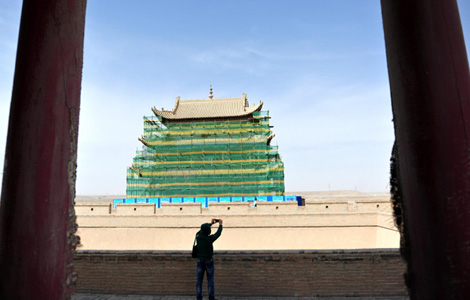
The eaves of a building at the Forbidden City feature colorful painting on the beams, lintels and ceilings. China Photo Press |
 |
|
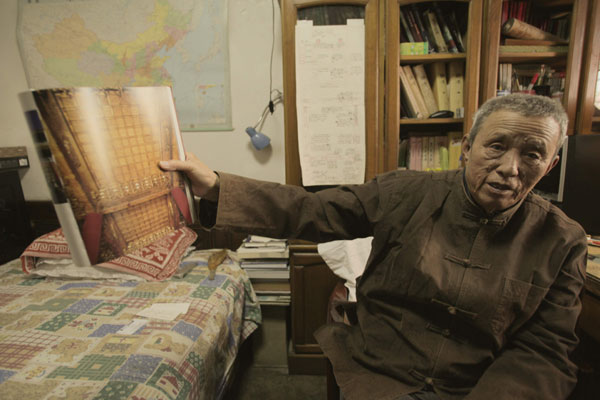
Wang Zhongjie, 79, has devoted more than 60 years to restoring color painting on ancient Chinese architecture. Yu ChenKang / China Daily |
The rich detailing on China's ancient architecture is becoming a lost art. Deng Zhangyu sits down with a master craftsman amid his sketching pencils and vivid paints.
|
 |
It's easy to find colorful painting on the beams, pillars, lintels and ceilings of ancient Chinese architecture, especially in imperial palaces. For Wang Zhongjie, a 79-year-old Beijing native, his life is intertwined with these rich strokes of gold, blue and red.
Sitting in his small bedroom with a century-old bed, a bookcase full of materials on painting and a shabby desk, the gray-haired senior keeps drawing various patterns for his art every day. It's been his life for years, even now when he struggles with an atrophic kidney. Unlike the young, accustomed to painting on computers, Wang persists in creating every pattern by hand on paper.
Wang calls himself a surgeon of color painting. In his friends' words, he takes the work so seriously that he makes it into a science - painting with detailed statistics based on his fieldwork.

"I want to make clear the DNA of every pattern drawn in different dynasties," says Wang.
From craftsman to designer to appraiser, Wang has devoted more than 60 years to repairing color painting on Chinese ancient architecture.
After primary school, Wang gave up his studies because of poverty. He became a craftsman, drawing and repairing color paintings at the age of 13, using skills that had been passed down from his grandfather to his father and then to him.
In 1956, Wang was recruited by the Institute of China Antique and Culture Heritage to take up research work on color painting across China.
To copy the color painting of Yongle Palace in Shanxi province, a Taoist temple, Wang spent seven summers there. Later he stayed for four summers in Suzhou and nearby cities well-known for their ancient gardens in Jiangsu province.
"I measured designs, copied them on paper and visited elderly craftsmen to learn their skills. I enjoyed my fieldwork and trips to these cities," Wang recalls.
"Thanks to my years of fieldwork, I can tell the date of a color painting immediately when I see it."
 |
Wang joined the Palace Museum staff in the 1970s and began to study the designs and patterns on the imperial palaces.
Color painting was used in ancient China to decorate and protect the timber framework. It also represented the social status of royal families: Only the emperors were allowed to use dragon images and the empresses to use phoenix images. Ordinary people, including merchants and the wealthy, couldn't have such paintings on their buildings.
"Just look at Taihe Palace (a place to hold rituals of the royal family) in the Forbidden City, there are tens of thousands of dragons painted on beams, walls, ceilings and pillars," says Wang.
"As for Fengxian Palace, the place to hold ceremonies to worship ancestors, it's all painted with beaten gold," he says.
Though an expert, Wang still maintains his huge passion for fieldwork and surveys.
When Wanshou Temple in Beijing was under renovation in the 1990s, a craftsman called him for his help one night to determine the accurate pattern of color painting on a beam. Wang told him to prepare a torch and a ladder, and he immediately proceeded to the site.
It took him about 10 minutes to determine the pattern and guide the craftsman on the spot. But by the time he got back home, it was early morning - as the temple was located in a distant suburb.
|
 |
|
Chinese art maintains distinctive presence in the Asian art market? |
Last year Wang went to an academic conference at Wudang Mountain in Hubei province. To observe the artwork on a mountaintop temple, the then already 79-year-old Wang climbed to the hillcrest, about 300 meters beyond where the upward-bound cable cars stopped.
"My students were nervous. They asked me not to do it. But I felt I was full of energy and excited to see the color painting of the temple," Wang laughs.
Every year, Wang goes to different cities across the country to help repair decorations on ancient buildings and temples. He loves it and is willing to share his knowledge, but he worries about how he will pass his skills to future generations.
"Young people now have better choices than a not-well-paid job like craftsman of ancient buildings," says Wang. "Scholars now prefer reading books to doing fieldwork.
"But traditional crafts and cultural protection need patience and devotion," he says.
Contact the writer at dengzhangyu@chinadaily.com.cn.

Copyright 1995 - 2010 . All rights reserved. The content (including but not limited to text, photo, multimedia information, etc) published in this site belongs to China Daily Information Co (CDIC). Without written authorization from CDIC, such content shall not be republished or used in any form. Note: Browsers with 1024*768 or higher resolution are suggested for this site.
License for publishing multimedia online 0108263 Registration Number: 20100000002731