

 Comments
  Print
Print  Mail
Mail  Large Medium Small
 |
|
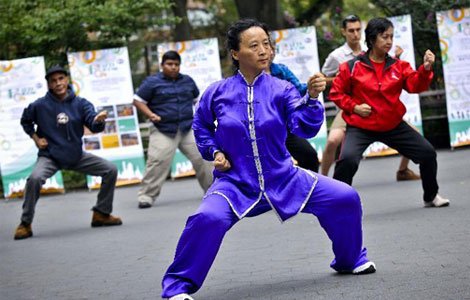
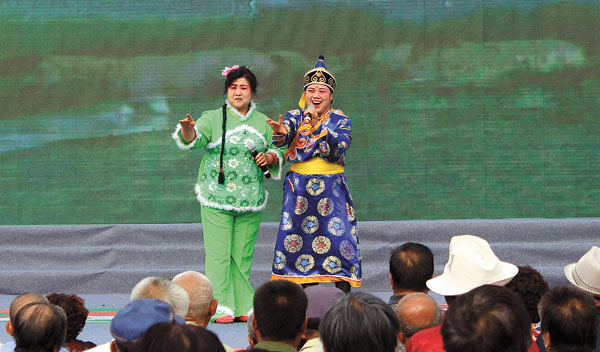
Liu Guoxian (left) and her community performance team enter the group finals thanks to their consistent practices. |
Errentai, literally meaning "two people on the stage", is a comedy traditionally performed by a dan (female role) and a chou (man clown role). It now features multiple roles.
The opera is of ambiguous origins, but is believed to have evolved in the late 19th century when immigrants from Shanxi province moved to Inner Mongolia, in search of better farmland. Several local opera varieties in Shanxi were influenced by and merged with various Mongolian ethnic group's music, such as long song. The opera is now popular in the west of Inner Mongolia, as well as northern parts of three nearby provinces including Shanxi, Shaanxi and Hebei. It became one of the first items listed as national intangible cultural heritages in 2006.
Errentai gradually evolved from relying on dialogue into a form of opera, when the amount of singing increased, most songs reflecting the realities of immigration and the tough day-to-day life in this half-agrarian, half-pasturing land. The opera also features other performances, such as acrobatics.
It uses the melodies of Mongolian music, but uses local dialects of the Han ethnic group. A typical accompanying band uses sihu (a four-string Mongolian-style bowed musical instrument), yangqin (a hammered dulcimer) and mei (an ancient kind of flute), but several other traditional musical instruments have also been used throughout the opera's history, according to Duan Bawang, a veteran errentai performer, also the head of Hohhot Folk Operas Troupe. Established in 1953, it is the first professional troupe whose repertoire includes errentai.
"It had been widely sung in countryside, but never on professional stages, which restricted its development," Duan says. "Many old performers were illiterate."
Errentai mimicked Peking Opera to develop its own academic system in the 1950s, dividing its basic skills into singing, talking, acting and dancing. Music notations were introduced to record old scores. County-level troupes later mushroomed, but there was little communication among performers from different areas until the first national competition was held.
"Young blood is urgently needed to inherit the tradition," Duan says. "But, unlike Peking Opera, small children are not suited to learn errentai.
|
|
|
| An opera legacy lives on | Tibetan folk art Batang Xianzi, a well-preserved tradition |




Copyright 1995 - . All rights reserved. The content (including but not limited to text, photo, multimedia information, etc) published in this site belongs to China Daily Information Co (CDIC). Without written authorization from CDIC, such content shall not be republished or used in any form. Note: Browsers with 1024*768 or higher resolution are suggested for this site.
License for publishing multimedia online 0108263 Registration Number: 20100000002731