Feeling the fun
 |
|
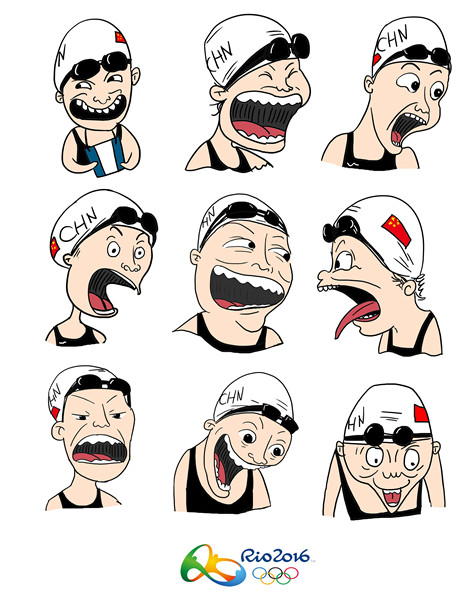
Emojis based on Fu Yuanhui's facial expressions are all the rage. [Photo/CFP] |
Who would have thought that the biggest Chinese star to emerge from Rio 2016 is not one of the world's fastest or otherwise most competitive. But Fu Yuanhui is in a league of her own.
In one fell swoop the 20-year-old swimmer knocked down from the pedestal the rigidly hallowed image of the Chinese sportsman as the solemn embodiment of a nation's hope and put fun back into sports.
And she did it without knowing the aftermath-just like she did not know she had won the third place in the women's 100m backstroke semifinal on Aug 8 when she was interviewed.
It was the video clip that gave full play to Fu's unique brand of charm, a rarity among Chinese athletes.
At the start of that post-swim interview, she knew she had broken her own record, but not that she was tied for third place. Given China's traditional emphasis on gold medals, a shared bronze medal did not seem enough cause for celebration. But Fu's spontaneous jubilation at her achievement-breaking her own record-put a human face on the catchphrase "be the best you can be!"
The reporter seemed to prod her into an alley of cliches-excuses such as "I did not sleep well last night" or "I've been suffering from a mysterious pain all week"-to hint at a better performance in an ideal situation.
But no, Fu did not take it. She uttered something that has since turned into a nationwide meme, covered by the international press and parsed by the translation community.
"I've been utilizing prehistorical powers," as she was translated by CCTV.
BBC retained this translation while The Guardian used "mystic energy".
It was a colorful way of saying "I've done my best" or "I've played to my full potential".
But that would have removed the sizzle from the steak. As a rule of thumb, I would tone down purple prose in translation and get to the point as much as possible.
But not this time, the hyperbole is such an essential part of her infectious persona that, if the word honghuang is not rendered more or less verbatim, it would have lost the raison d'etre for the moniker "honghuang girl".
Honghuang, literally flood and wilderness, refers to time immemorial. So, CCTV's "prehistorical" is not really wrong. Yet it could be misleading because it could also mean outdated. Another word that conjures up the image of flood is antediluvian, which also carries the connotation of old-fashioned.
What Fu meant was, "I've been availing myself of all the strengths, forces and energy that I've been gathering since ancient times".
So, primeval or primordial seems to be a good trade-off between the mythological images of flooding and the distracting meaning of obsolescence.
And "mystic energy" actually hits the right note because the current use of the Chinese term is from a Taoism-accentuated TV drama of flying swords and age-defying fantasy.
Fu's verbal flight of fancy jibed perfectly with her facial expressiveness. Screen shots from that interview have triggered an outburst of imitations in emojis and live performances.
While a few were uncomfortable with what they deemed to be a clownish act, most have embraced her as a symbol of "to thine own self be true".
 |
|
RAYMOND ZHOU |
The Hangzhou native did not mean to entertain; she was simply being herself, steadfastly ignoring the implicit dictum of political correctness. For example, she described her training as "sometimes worse than death". Most would have stuck to the uplifting tone: "It was hard but I persevered."
Such remarks would have got her into big trouble had they appeared two decades ago. Olympic athletes were-and still are-supposed to represent their country in more ways than one. Their personal feelings were irrelevant to the public. They were perceived as gold-hauling machines. If they failed that function, they would be thrown mud of the worst kind.
When Zhu Jianhua brought home only the bronze medal from the 1984 Olympics (after he had made three consecutive world records), the windows of his Shanghai home were smashed.
When star gymnast Li Ning failed to repeat his stellar performance in the 1988 Olympics, he was turned into a pariah. The newspapers said he should "go hang himself".
When Liu Xiang, China's biggest track star, had to pull out at the last minute during the 2008 Beijing Olympics, disappointment quickly turned into opprobrium. Some TV commentators suggested it would be more honorable for him to fall and die on the track.
These are some of China's greatest athletes who had won huge accolades for the country. But few seemed to care that they were first and foremost flesh-and-blood human beings with physical and emotional frailties. Against such irrational expectation and grueling regimens of training, no wonder few can afford to enjoy the process of competition.
Once China came up with the largest hoard of gold medals in the Beijing Olympics, a new mentality started to gain traction.
Sports, some have been arguing, should be more about the fun of sportsmanship than about gold medals. Now that we have seen the glory of the result-oriented approach-albeit only the tip of the cost iceberg-shouldn't we graduate to the process-oriented approach?
Out of this phase of subtle transition came Fu, whose elation at winning a bronze was so heartwarming and hilarious that it touched a nerve as inherently significant as seeing a Chinese flag rise in an Olympics stadium.
There have been Chinese sports heroes like Lin Dan and Yao Ming who added flair to ultimate gamesmanship. But the self-effacing Fu is much more relatable-and her immediate popularity reflects the growing maturity of a public whose fixation is shifting from the medal tally to human dimensions of the athletes.
China needs more sports heroes, or rather, more diverse types of ace athletes. Fu has just broken the stereotype by being unwilling-or unable-to fit into the uptight mode.
"If one day I become demure and wear a shy smile, I'd hate myself," she said.
Win or lose, she has exuded a personality that's forever winning.
Contact the writer at raymondzhou@chinadaily.com.cn