|
There is a tomb dedicated to Zhang Sanfeng at Qiyun – but it's empty. According to Chinese myth, on ascending to heaven one's corporal remains vanish without a trace in the temporal world.
My friends and I arrived at Qiyun in the afternoon. To save time we decided to give up the idea of scaling the mountain on foot, which would take about three hours if we took the shortest route, and opted for the cableway.
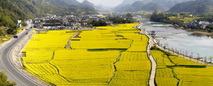
As our gondola rose higher and higher, our view of the surrounding land broadened. Below us rapeseed fields were in full blossom, lending a golden splash to the riverbanks and valley floors. Scattered among the yellow were clusters of cottages constructed in the style typical of the area – white walls and dark tile roofs. It was an idyllic picture of the countryside, and one that seemed – to us in our gondola, at least – untouched by time or trend.
Reaching a lower peak, we hopped out of our cablecar and found ourselves at the Wangxian (Watching the Immortals) Pavilion. Following our guide, Mr. Wang, we walked down the Peach Blossom Valley towards Dongtianfudi, the Taoist appellation for the 'residence of immortals' that literally means 'a sacred spot concealed from the outside world'. There are many Taoist sites in China of the same name, but this one stands out due to its abutting the Peach Blossom Valley. Such a valley is a metaphor for Lost Paradise in Chinese.
Dongtianfudi is the site of Zhang Sanfeng's tomb. Also in the area are three examples of fine cliff carvings at the Xizhen, Zhonglie and Shouzi rock faces.
Mr. Wang is from one of the mountain's traditional Taoist families. His grandfather and father were both abbots at a local Taoist monastery, and he is a pious believer himself. Wang sees Qiyun Mountain as different from other Taoist holy sites. For one, it is open to both religious and secular communities, and non-Taoists reside alongside the faithful in the mountain's villages. This mixing can be best seen along Yuehua Street, where a motley collection of buildings – some cloisters, some residences and some plain old shops – jostle for spiritual and commercial customers.
Almost all visitors make a stop at the Mengzhen Bridge in Peach Blossom Valley. Many tie a yellow ribbon on its stone rails after making a wish. Mengzhen actually translates as 'a dream coming true'in Chinese. The bridge leads to a flagstone path built during Ming Dynasty Emperor Zhengde's reign (1506-1522). Mosses grow on the stones, undergoing centuries of pilgrims' treading.
Hermits and Deities
According to Wang, in former times Taoism was popular among those who wished to escape the commotion of worldly life by seeking refuge in sequestered mountain caves for meditation. Most Taoist shrines are built on mountains for this reason. The reputation of Qiyun Mountain historically drew in many believers and practitioners who spent long years holed up in grottos on the mountain's cliff faces.
An indigenous religion that began to form into a comprehensive philosophical system about 1,900 years ago, Taoism is believed to have its origin in worship of gods and ghosts in prehistoric times. Its believers practice alchemy, exercise their breathing rhythms and meditate, among many other activities, in the hope of eventually gaining immortality. The central tenet of the religion is harmony between man and nature, and between the mind and the body.
Taoism has a syncretic mix of gods, which are mostly borrowed from a melange of local cultures and traditions. Some Taoist historical figures have also been canonized and subsequently worshiped.
Among the ranks of gods are those that watch over other 'planets' such as the sun and the moon, those who assume natural formations like mountains and rivers, as well as those who manipulate specific aspects of our daily life, including the God of Kitchen. Many gods are revered by all Taoist followers; others are native icons of specific regions, and their influence and worshippers remain localized.
This great diversity and inclusive spirit is present on Qiyun Mountain, where shrines can be found to the Eight Immortals of Taoism, the goddess in charge of fertility, the Eighteen Arhats from Buddhism, Lord Zhenwu, the guardian of Qiyun Mountain, and the folkloric Dragon King and the God of Learning. Qiyun represents a truly remarkable confluence of China’s major philosophical systems.
Cliff Carvings
The visitors to Qiyun over the course of history, many of whom were artists and scholars, have left their mark on the mountain. The most ambitious among them would have their writings engraved on the cliff faces of Peach Blossom Valley and other scenic – and sacred – spots.
According to Mr. Wang, such carvings could be found at 1,000 locations in the past, but only 538 have been preserved to date, with the oldest dating back to the Northern Song Dynasty (960-1127). The loss can be attributed to a number of causes. Some later visitors scratched off the old inscriptions to make way for their own writings, and harsh weather conditions higher up the peaks have resulted in considerable erosion.
The carvings are generally poems, records of events and religious scripts. Writers were often officials, artists and intellectuals. Some were renowned in their respective fields; most were not. In judging the artistic merit of the carvings, handwriting is important, but chiseling into rock is an equally demanding skill. Anhui province boasts some of China's best stonecutters, who over the centuries have developed a distinct carving style of their own. The abundance of experienced hands is the reason why such a large number of cliff carvings can be found on Qiyun. Carvers would come here to prove their mettle, and make money.
During one of his inspection tours of southern China, Qing Emperor Qianlong (1711-1799) was fascinated with the sights at Qiyun, and made an inscription for the mountain: 'Unraveled beauty on earth, Number One mountain in the south.'
 |
|
Taoism, Buddhism and Confucianism co-exist peacefully in this region.
|
|