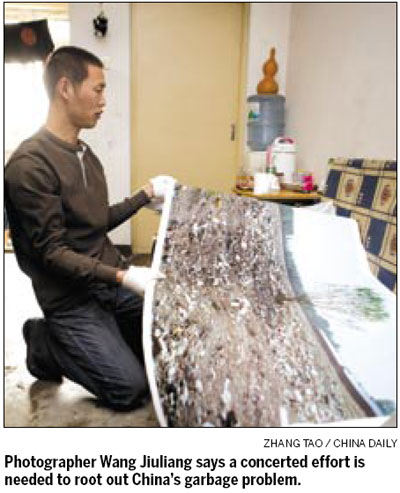
He is a photographer who has recorded some of the dirtiest places in China. But he is also an environmentalist who wants to reveal the truth about trash. Meet Wang Jiuliang, a 34-year-old gold award winner for Outstanding Artist of the Year at the 2009 Lianzhou International Photography Festival.
Instead of using his fame to make money, Wang spends his time documenting the garbage situation in China, which, in his opinion, is a more meaningful way to utilize his talent.
"I don't want the award to bring honor to myself. I would rather society realize the fact that we are living in a city surrounded by trash. I want to raise environmental awareness in every citizen's mind. That would be the best prize for my work."
Wang has mapped out and visited more than 400 landfills around Beijing since 2008.
The idea of photographing garbage started during a visit to his hometown of East China's Shandong province during the year of the Beijing Olympics. He found a river not as clear as it used to be, millions of plastic bags used for farm chemicals and pesticides dumped on the land. He realized the plastic bags and garbage would never disappear unless he and others took action.
Back in Beijing, while planning a photo shoot on consumer behavior in the city, he started locating and collecting information on landfills around the capital.
"The landfills are like a mirror; they reflect the high rate of expansion of the city," Wang said.
People see construction going on every day in Beijing and see the demolition of old buildings and the rising of new ones. But "what we don't see is the tons of construction rubbish and domestic garbage", he said.
To capture the reality of the city surrounded by garbage, Wang covered 7,500 kilometers on his motorbike and took photos of 13 large landfill sites, covering an area of more than 10 square kilometers in a two-year period.
Even though Wang has become a successful photographer, he has never lost his respect for junk collectors, who are prominently featured in Wang's work. He said they are an important part of society, and by sorting through and recycling items in a landfill, they reduce the amount of trash. But he admits that it wasn't easy to photograph them at first.
"They have their own life," he said. "Most of them had never had their photo taken before."
Eventually they accepted him and he took many photographs of the children who were born and grew up in trash heaps. In the end, he gave them more than 100 photos as gifts.
"I am happy to help them record their lives," he said.
While photographing the garbage sites around Beijing, Wang also filmed them. A documentary was shown to a small group of people in Beijing in early April. A 200-seat theater was filled, with Wang's friends and people from media organizations spilling out into the aisles.
In order to ensure the audience's safety, the theater manager decided to show it again.
"I am glad to see that my work has been appreciated by so many people in China now," Wang said.
After the premiere, Wang was invited by the University of California, Berkeley, to talk with American scholars who specialize in Asian trash studies. One professor gave a speech on how China has dealt with trash over the years, including the development of China's current refuse disposal system, first introduced in 1949.
During his 10-day trip, Wang looked inside about 10 garbage bins along the streets of Berkeley, took the trash out of the bins and photographed it. A 50-year-old woman told him not to worry, because "someone will come to take care of the trash and they will get it sorted out and recycled".
The following day he visited a sanitation transfer station, where he was told that many of the recyclable items are sent to other countries, including China.
While China is following Western countries to promote sorting recyclable materials, Wang plans to visit many cities to photograph dumped papers, shoes, tires and plastic products from overseas.
"I am sure if the sorted items were good or no harm for the environment, they (the Americans) would keep it in their home country," Wang said. In his opinion, sorting recyclable materials and sending it away is a joke rather than a solution for China.
He said just because trash isn't in plain sight, doesn't mean it doesn't exist. "Where do we want to transport our garbage?"