Over the past four decades, the economic structure of Shanxi province has undergone dramatic changes. The proportion of the primary, secondary and tertiary sectors of the economy changed from 20.7:58.5:20.8 in 1978 to 4.6:43.7:51.7 in 2017.
Over the past 40 years four of reform and opening up, especially since the 1990s, Shanxi has rapidly developed its transport and communication infrastructure.
As part of Shanxi province's continued efforts to implement reform and opening up, by the end of 2017 it had established trade relations with 27 countries on five continents.
The per capita disposable income of urban residents in Shanxi province increased from 301 yuan ($43.36) in 1978 to 29,132 yuan in 2017, 96.7 times more than that of 1978.
A total of 16 Shanxi companies have been exhibiting their high-tech achievements and projects and seeking fresh business opportunities at the 20th China High-tech Fair which opened in Shenzhen, South China's Guangdong province, on Nov 14.
Yuncheng government has recently signed a memorandum of cooperation with Shanxi Provincial Committee of China Council for the Promotion of International Trade to help boost the city’s exports.
More than 5,500 residents in Lingqiu county, Datong city, have recently had access to heat created by winter power as a 400,000-kilowatt wind power heating demonstration project has started operating in the county.
China's first research and development and processing center for high-pressure and low-temperature food processing has recently been established in Shanghai with equipment manufactured by Shanxi province.
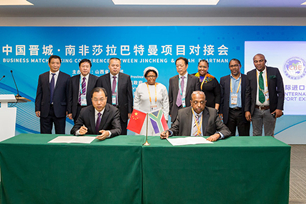
Jincheng city in Shanxi province and Sarah Baartman District Municipality in South Africa signed a framework agreement on economic and trade collaboration in Shanghai on Nov 6.
Sujin Energy Holding Co, a joint energy company between Shanxi and Jiangsu provinces, established its headquarters in Shuozhou city, Shanxi province, on Nov 5.