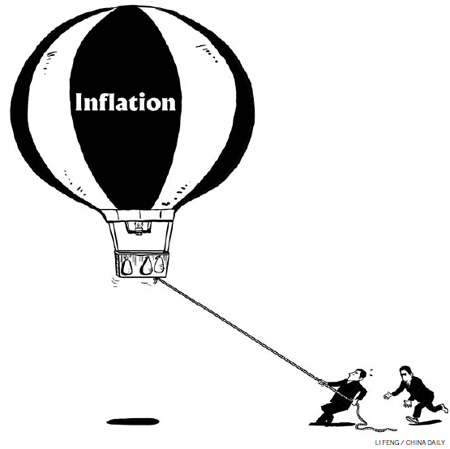
Curbing soaring prices has become a priority for China. In May the consumer price index (CPI), a measure of inflation, reached 5.5 percent year-on-year, a 34-month high, according to the National Bureau of Statistics.
Inflation is the result of the government's loose monetary policy since late 2009 which allowed extra money to flow into the economy, says Liu Lingling, professor of economics at Tsinghua University. The broad currency supply, or M2, in China reached 76.34 trillion yuan ($11.78 trillion) in May.
|
||||
Two types of inflation have pushed the CPI to a historic high, namely, imported inflation and cost-push inflation.
The second round of quantitative easing (QE2) in the United States, the deprecation of the US dollar and the debt crisis in the eurozone, have increased bulk commodity prices in international markets and, by default, raised the cost of China's imports. They have prompted more international hot money to flow into China, too. But despite being highlighted by the Chinese media, imported inflation is not a significant factor.
The cost-push inflation - inflation caused by substantial increases in the cost of necessary goods or services for which no suitable alternative is available - is more dominant, she says.
Three factors have paved the way for China's rapid economic growth with relatively low inflation over the past three decades: comparatively cheap labor, government-controlled prices of natural resources including gas, water and electricity, and the ignored environmental cost. They contributed to the relatively low cost of production.
But all the three costs are rising now.
The Chinese economy faces a shrinking migrant workforce because of demographic changes. The shortage of migrant workers in recent years is there for all to see.
Authorities control the prices of important natural resources, too, a practice that has survived since the planned economy days. The problems that the distorted prices created lay dormant and have surfaced today.
 New type of urbanization is in the details

Copyright 1995 - . All rights reserved. The content (including but not limited to text, photo, multimedia information, etc) published in this site belongs to China Daily Information Co (CDIC). Without written authorization from CDIC, such content shall not be republished or used in any form. Note: Browsers with 1024*768 or higher resolution are suggested for this site.
License for publishing multimedia online 0108263 Registration Number: 130349