Constant military exercises and more American troops and warships in Asia only add to regional uncertainties
Mutual distrust of long-term intentions has become a central concern in US-China relations.
Wang Jisi, director of the Center for International and Strategic Studies, and Kenneth Lieberthal, director of the John L. Thornton China Center of the Brookings Institute, lay out both the underlying concerns each leadership harbors about the other side and the reasons for those concerns in their paper "Addressing US-China Mutual Distrust", which was published in March.
The report highlights that though neither side wants an adversarial relationship, both worry that it may become unavoidable, noting that as the power gap between the US and China is narrowing, each country has an underlying and growing distrust of the other's strategic intentions. The authors point out that this distrust "is corrosive, producing attitudes and actions that themselves contribute to greater distrust".
The authors conclude there are three fundamental sources of growing strategic distrust between the US and China: different political traditions, value systems and cultures; insufficient comprehension and appreciation of each other's policymaking processes and relations between the government and other entities; and a perception of a narrowing gap in power between the United States and China.
But while Beijing has consistently demonstrated the desire to "increase trust, reduce trouble, develop cooperation, and refrain from confrontation" in Sino-US relations, the US acts from narrow self-interest and promotes the "China threat" in pursuit of hegemony and economic advantage.
At the Pentagon on Jan 5, 2012 in his remarks on the Defense Strategic Review, US President Barack Obama said that although the US military would become leaner, "we will be strengthening our presence in the Asia Pacific, and budget reductions will not come at the expense of that critical region".
Under the pretext of "freedom of navigation", the Pentagon is repositioning military assets to maintain its strategic dominance in the South China Sea and over key "choke points", such as the Strait of Malacca.
About 80 percent of all oil brought into China crosses the Indian Ocean from the Middle East and Africa, and enters the South China Sea through the Strait of Malacca.
The US has deployed ships to the Philippines and troops in Darwin, Australia, and Singapore.
Agreements with Australia and Singapore are the model for the new US posture in the region. The US has plans in four different locations in Australia, which is emerging as Washington's most dynamic bilateral military relationship in the region.
During his visit to Australia in November 2011, Obama underscored that his administration's aggressive intervention into the Asia-Pacific region is aimed at undercutting China's growing influence and said China should play "by the rules", meaning that China should abide by the "rules" laid down by the US - that is, a world order dominated by American economic and strategic interests.
Whereas the US's regional focus has long concentrated on Northeast Asia, that gaze is now shifting to Southeast Asia. In a briefing on Asia-Pacific military issues in Washington on January 27, Admiral Robert Willard of the US Pacific Command said, "I look at where the forces are and where they need to be present day to day, we are biased in Northeast Asia. And when we look at Southeast Asia and South Asia, the pressure is on Pacific Command to deploy and sustain forces there day to day."
The refocus on Southeast Asia is part of the US' strategic pivot to the Asia Pacific. This has involved taking its partnership with ASEAN to a "new strategic level", confirmation of a special representative and policy coordinator for Myanmar, and a deepening of US bilateral relations with different regional nations.
In January 2012, Philippine defense officials visited Washington for strategic talks and left with an agreement to increase cooperation in areas including maritime security, defense, commerce, and disaster relief. A "rotating" and "frequent" US presence was discussed.
Defense and foreign affair officials from the Philippines will meet their US counterparts in Washington on April 30. They are expected to discuss issues including shoals owned by China in the South China Sea.
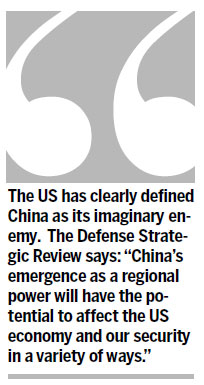
The US' Strategic Defense Review came with a warning for China that its military power "must be accompanied by greater clarity of its strategic intentions in order to avoid causing friction in the region".
Yet China has consistently clarified that it adheres to a path of peaceful development and its military modernization is to protect its territory and interests and to help it fulfill its international obligations.
US Chairman of the Joint Chiefs of Staff Martin Dempsey has said that he thinks the US' strategic pivot to Asia is "more opportunity than liability to improve our relationship with China".
But this can only happen if the US shows greater trust and plays its cards right.
The author is a senior writer with China Daily. E-mail: caihong@chinadaily.com.cn
(China Daily 04/24/2012 page8)

Today I chatted with my colleague. "Have you ever sent some gifts to your child’s teacher", he asked. "Never once", I answered firmly.

Copyright 1995 - . All rights reserved. The content (including but not limited to text, photo, multimedia information, etc) published in this site belongs to China Daily Information Co (CDIC). Without written authorization from CDIC, such content shall not be republished or used in any form. Note: Browsers with 1024*768 or higher resolution are suggested for this site.
License for publishing multimedia online 0108263 Registration Number: 130349