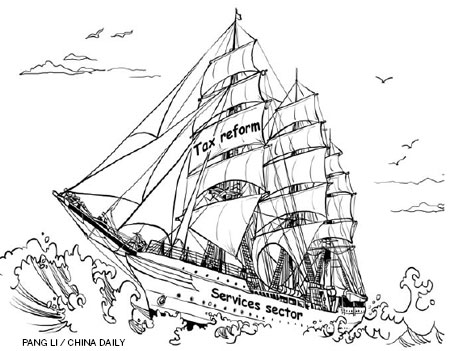
China has introduced new value added tax (VAT) reforms across 10 cities and provinces, including Beijing and Guangdong province. The reforms, to be phased over the next six months, come on the heels of a successful VAT pilot program started in Shanghai in January.
The business community has welcomed the reforms, especially because of the current global economic uncertainty. The reforms will align China's indirect tax system with the world's best practices, reflecting the government's commitment to promote the growth of the services sector as part of the 12th Five Year plan (2011-15).
For many years China has had a dual system of indirect taxes - a VAT applicable to goods and a business tax applicable to the services industry.
A VAT is essentially a tax collected by businesses. But ultimately, it is embedded in the final price charged to an end consumer. While it is collected by each business in a supply chain, credits are generally granted for purchases made by each business in the supply chain, so that only the final price bears VAT. This tax is now charged in more than 150 countries.
In contrast, business tax is a type of turnover tax - it is payable in each stage of a supply chain. It means that if one business provides a service to another, then the business tax is payable again, and again, until the service is eventually provided to the end consumer. Economists generally describe these types of taxes as "cascading" taxes, and they are inefficient for modern economies.
In China, VAT is going to replace business tax. To manage the transition most effectively, these reforms are initially being implemented through a pilot program that started in Shanghai on Jan 1, and are applicable to the transportation and modern services industries. The Shanghai pilot program has been very successful, with about 90 percent of businesses benefiting from a reduced tax burden, according to information from the Shanghai Finance and Tax Bureau in June.
The estimated VAT tax revenue since it was introduced in Shanghai is 8.45 billion yuan ($1.33 billion) compared with the business tax revenue for the equivalent period of 9.364 billion yuan ($1.47 billion), which is a reduced tax burden of 10 percent.
On July 25, the State Council announced that the VAT pilot program would be expanded to 10 cities/provinces. The dates for implementation are as follows: Beijing from Sept 1; Jiangsu and Anhui provinces from Oct 1; Fujian (including Xiamen) and Guangdong (including Shenzhen) provinces from Nov 1; and Tianjin, and Zhejiang (including Ningbo) and Hubei provinces from Dec 1. The rules in each of these cities/provinces will be the same as those in Shanghai.
Businesses that earlier paid business tax will now pay VAT, either at the rate of 6 percent (for modern services industry) or 11 percent (for transportation industry). Small-scale taxpayers will pay at the rate of 3 percent compared to the business tax of 5 percent.
These new rates will accompany the general VAT rate applicable to the goods sector of 17 percent. Interestingly, these new rates compare favorably with the international average VAT rate which now exceeds 15 percent, according to the KPMG Corporate and Indirect Tax Rate Survey that was released on Oct 1, 2011.
Importantly, the VAT pilot program will create an impact not only on businesses in the services sector, but also all businesses. For example, when manufacturing companies buy services, they will now be eligible to claim a VAT credit for the cost of the services, whereas previously business tax was embedded in the price. This should reduce costs for manufacturers. And businesses in the services sector that become VAT payers will now be eligible to claim VAT credits for goods, fixed assets and services they purchase.
Finally, from the perspective of international competitiveness, the new VAT system is more attractive, because many services being exported or imported will now carry no effective VAT cost when earlier a business tax of 5 percent was imposed.
The VAT pilot program is likely to be expanded to other sectors such as construction and real estate, financial and insurance services, entertainment, and post and telecommunications from 2013.
Once complete, the changes will unify the indirect tax system applicable to the goods sector with that of the services sector. In doing so, it will remove inefficiencies in each of these systems.
For obvious reasons, reforms such as this are a massive undertaking. The tax authorities have been working hard to help businesses implement these changes, which affect personnel from sales, procurement and marketing to legal, IT and finance departments of a business.
Challenges are inevitable during the transition period, when different cities and provinces will change over from business tax to VAT and new industries become VAT payers. But the final outcome will be a more internationally competitive tax system to promote the growth of the services sector in China.
The author is tax partner of KPMG China.
(China Daily 08/21/2012 page9)


Charlotte and Emilie Meaud, twin sisters, were killed at the terrace of the Carillon, during the attacks on Paris, on the 13th of November.
Copyright 1995 - . All rights reserved. The content (including but not limited to text, photo, multimedia information, etc) published in this site belongs to China Daily Information Co (CDIC). Without written authorization from CDIC, such content shall not be republished or used in any form. Note: Browsers with 1024*768 or higher resolution are suggested for this site.
License for publishing multimedia online 0108263 Registration Number: 130349