In an escalated conflict that neither side wants but neither can afford to lose, resorting to negotiations is the best way to de-escalate the situation. The territorial dispute between China and Japan over the Diaoyu Islands calls for such negotiations. However, it is practically difficult for such negotiations to begin.
The Japanese central government tried to create an impression that it "nationalized" the Diaoyu Islands reluctantly. But Japan's motive is widely seen as being different and the Chinese mainland and Taiwan both have strongly opposed it.
China's reaction has been strong. To avoid being held accountable for escalating the dispute, Japan is trying in vain to remain acquiescent.
But inadvertently, it is worsening the situation by giving Japanese people the impression that the Chinese mainland and Taiwan are the ones creating trouble.
Behind the scene, there is the infamously ambivalent United States, which does not have any plan to defuse the situation.
Washington let go of an early opportunity to help defuse the tension when US Secretary of State Hillary Clinton gave just a cautionary nudge to Japan for its indecision over how to deal with Japanese right-wing forces' belligerent attitude toward China in the Diaoyu Islands issue.
For the US, intensification of the dispute between Japan and China, including a military standoff, could be mixed blessings. It would give Washington an opportunity to check out China's military might, check its rise and justify its continued, if not fortified, presence in Asia. These immediate gains to be made by the US explain why it issued a provoking message - that its security treaty with Japan covers the Diaoyu Islands - in the initial stages of the crisis.
But a full-blown conflict could also mean the failure of the US' brinkmanship. The situation could spiral out of the US' control, with the chance, even if little, of drawing Washington into direct confrontation with Beijing.
This US' ambivalence has helped extremists in Japan first wag Tokyo's tail before moving to Washington's tail. The US has wasted its leverage by failing to persuade Japan to repeal the "nationalization" of the Diaoyu Islands in time.
The dispatching of an envoy by Japan to Beijing was at best a false promise, because envoys sent by Japan to China before a confrontation - in 1894, 1905 and 1931, for example - have not been able to solve any problem, because they have always conveyed a message of "apology": Japan's policy is irrevocable and the other side has to give in to avoid conflict.
Usually, the other side mistakes an envoy as a messenger of peace, which obviously does not apply to Japanese envoys. If this has been Japan's history, how can China accept Japan's "apology". It is even more difficult for China to accept it because it believes Japan is getting ready for a showdown.
Neither side wants a war. But neither is ready to back down from its adamant position. A compromise doesn't seem to be in the offing, because unilateral initiation by any of the two sides would be seen as surrender.
For simultaneous reconciliatory moves, however, the two sides first need to resume talks.
This too is unlikely because the situation has reached such a stage that even a hint by one of the two sides of its willingness to negotiate could be interpreted as surrender. The standoff seems to have shut off all windows of mutual benefits between China and Japan.
The US could have persuaded the two sides to open a window of negotiations. But it has lost its credibility for shamelessly seeking to cash in on the situation in the early stage of the crisis.
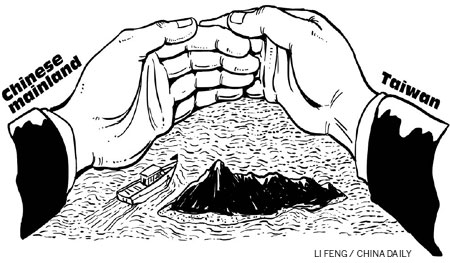
The only concerned party that could threaten no one else and has remained friendly connected with other sides is Taiwan. Perhaps Taiwan can shuttle between the mainland and Japan to settle the dispute as an intermediary.
Only if the two sides, especially Japan, revert to their previous stance of "shelving disputes" to deal with more pressing issues can the crisis be prevented from spiraling out of control.
The author is a professor of political science at National Taiwan University.
(China Daily 09/21/2012 page9)
Copyright 1995 - . All rights reserved. The content (including but not limited to text, photo, multimedia information, etc) published in this site belongs to China Daily Information Co (CDIC). Without written authorization from CDIC, such content shall not be republished or used in any form. Note: Browsers with 1024*768 or higher resolution are suggested for this site.
License for publishing multimedia online 0108263 Registration Number: 130349