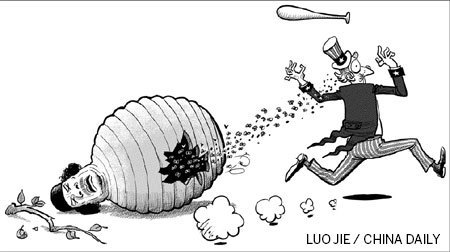
The tragic, horrific death of US Ambassador to Libya J. Christopher Stevens at the hands of an extremist mob is a sad case of chickens coming home to roost for US and Western policymakers.
The US government led by President Barack Obama strongly supported the toppling of longtime Libyan leader Muammar Gadhafi at the hands of a popular movement in October 2011. The revolution could not have succeeded if Britain and France, backed by Washington, had not flown months of air support missions for the rebels. These proved decisive in turning the tide.
Since then, Obama, to his credit, has resisted calls from both neo-conservative and militant liberal, often called neo-liberal, pundits in the US media to intervene on the side of the Syrian rebels currently fighting against President Bashar al-Assad.
In general, Obama has continued the policy of active ideological support for so-called democratic movements and protests across the Middle East that he inherited from his predecessor, Republican president George W. Bush, who dispatched US armed forces to Afghanistan and Iraq on modernizing, democratizing and even-nation-building (especially in the case of Afghanistan) missions. Bush in his second inaugural address in January 2005 pledged as a major US strategic priority the spreading and establishment of democratic regimes across the Middle East. Two of the leading neo-conservative pundits, Charles Krauthammer and William Kristol, were widely reported to have played major roles in drafting that speech.
This policy of spreading democracy at accelerated speed across Middle East societies has, therefore, become bipartisan policy orthodoxy in Washington. Politicians and pundits on both the conservative-Republican and liberal-Democrat sides of the ideological divide enthusiastically, repeatedly and indeed mindlessly continue to express it on every possible occasion.
Ironically, this policy puts the US on the "left" or revolutionary side of the global political spectrum, using the terms and definitions that have been universally employed for more than 220 years since the French Revolution. As the superpower promoting continued revolution in the name of democracy around the world, especially in the Middle East, the US has become the power promoting revolutionary change and destabilization of governments in the name of its own ideological values and standards around the world.
In contrast, Russia and China have become the 21st century's powers of the "historic right", that is to say, on the global scene they support stability and follow values of pragmatic realism in their foreign policy and global diplomacy. China in particular favors peace and stability across the Middle East because it imports so much of its oil from the region.
The toppling of established governments in countries such as Egypt and Libya, of course, did not lead to the magical emergence of a stable, free market, pro-American democracies, any more than it had done in Iraq and Afghanistan. Nor will that happen in Syria if Bashar al-Assad is toppled, which I think is increasingly unlikely.
Instead it led to the establishment of mob rule in Egypt and Libya with a weakened new central government and the freedom for terrorist forces to establish themselves and carry out atrocities in a way that would not have been possible under the previous, long-lasting and stable central governments.
In other words, the terror attack and mob violence that killed Christopher Stevens in Benghazi would not have been at all possible while Gadhafi, ironically a sponsor of terrorism on a global scale decades before, was still in power. Nor can we define the increasing chaos and violence in Syria simply as a struggle for freedom by long-oppressed and suffering innocents.
Instead, as the noted American military analyst William S. Lind wrote in The American Conservative recently, the Syrian chaos shows the characteristics of an ultra-violent teenage, super-gang culture of the kind that has enveloped large areas of many mega-cities around the world, including even in the US. Such explosions of super-gang violence and aggression generate a disproportionately high number of gratuitous murders and rapes.
Stevens' gruesome death should therefore be a wake-up call to US policymakers to act more cautiously on the world scene and in cooperation with other major powers such as China and Russia, and not regard explosions of popular protests in countries as reasons or excuses to intervene on their behalf.
The author is chief global analyst of The Globalist, a political columnist for the Baltimore Post-Examiner, and former chief foreign correspondent for The Washington Times.
(China Daily 09/24/2012 page9)

I’ve lived in China for quite a considerable time including my graduate school years, travelled and worked in a few cities and still choose my destination taking into consideration the density of smog or PM2.5 particulate matter in the region.

Copyright 1995 - . All rights reserved. The content (including but not limited to text, photo, multimedia information, etc) published in this site belongs to China Daily Information Co (CDIC). Without written authorization from CDIC, such content shall not be republished or used in any form. Note: Browsers with 1024*768 or higher resolution are suggested for this site.
License for publishing multimedia online 0108263 Registration Number: 130349