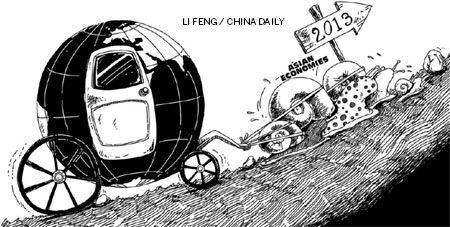
The growth rate of emerging Asian economies is expected to increase in 2013. But inflation and gloomy external conditions still pose a challenge for the macroeconomic policies of many of these economies. In the medium term, their growth rate will be higher than other regions but lower than it was before the global financial crisis. This squarely puts the focus on economic reform and restructuring.
Though Asia's economy is likely to bottom out this year, it will find it difficult to overcome the problems created by the sovereign debt crisis in Western countries. Besides, emerging Asian economies face several source risks.
First, they cannot avoid the impact of the slow growth and weak demand of developed economies, which will take a long time to emerge out of the sovereign debt crisis despite deleveraging.
Second, emerging Asian economies experienced fast paced growth because of excessive credit delivery. Now that credit delivery has trickled, they are stumbling. In the first half of the 1990s, a similar phenomenon led to the Asian financial crisis. During the ongoing global financial crisis, because of frequently adjusted macroeconomic policies, the asset bubbles in many Asian countries haven't deflated to the level of developed countries. But the recent turbulence in Vietnam's financial market is the result of excessive credit delivery.
Third, quantitative easing (QE) by the United States, the eurozone and Japan has had a considerable effect on emerging Asian economies. Because of Asian economies' export-oriented development model and their asset bubbles, overseas short-term capital flow will probably lead to appreciation of exchange rates. It is also likely to trigger inflation and further inflate the asset bubbles.
If the QE in the West succeeds in reversing the price rise, then the transfer of debts could be a way out of the sovereign debt crisis. Therefore, emerging Asian economies, as the biggest foreign exchange reserve holders, must take steps to avert the risk of debt transfer from developed countries.
Fourth, the Diaoyu Islands dispute between China and Japan poses a serious risk to Asia's economies. China and Japan are Asia's two largest economies and the mainstays of East Asia's global production network. Any deterioration in Sino-Japanese ties, therefore, will have an impact beyond the two countries' economies.
Moreover, the Diaoyu Islands dispute is likely to linger for a long time, therefore, Sino-Japanese economic ties cannot be strengthened. This exogenous factor will increase uncertainties in the Asian economy.
Considering the source risks, Asia's emerging economies have no option but to take up economic reform and restructuring in order to pursue sustained growth.
The aggressive economic stimulus packages in the wake of the global financial crisis gave policymakers in emerging Asian economies a sense of false confidence that they were largely immune to external crises. They also undermined the emerging economies' impetus to change their development model. Now, the economic trends of the past four years show that overcoming the impact of the global financial crisis is the toughest challenge the Asian economies face.
Emerging Asian economies, including China and India, have indeed placed reforms high on their agendas. True, economic reforms and restructuring in Asian countries have certain factors in common, but their focus differs.
The overall performance of emerging Asian economies, however, depends to a large extent on Asia's economic integration. In the past, regional cooperation frameworks such as ASEAN+3, ASEAN+6 and a free trade agreement (FTA) among China, Japan and the Republic of Korea were promoted by Beijing and Tokyo without the involvement of Washington. But since the Diaoyu Islands dispute has soured Sino-Japanese ties and the US has been pushing ahead with its brainchild, the Trans-Pacific Partnership, new avenues have to be explored for regional economic cooperation.
China will not join the TPP under its current framework, though the prospects of negotiations are still promising. In November 2012, Thailand agreed to join the TPP talks, and half of ASEAN member states are likely to join the US-led group by October 2013.
Moreover, the Sino-Japanese dispute over the Diaoyu Islands imperils not only bilateral diplomatic relations, but also economic ties. Against this background, it would be over-ambitious to begin trilateral FTA talks. But the three-way pact was being jointly pursued because of the persistent will of the three countries to deepen cooperation. It is likely then that FTA talks between China and the ROK will precede that among China, Japan and the ROK.
Also, the Regional Comprehensive Economic Partnership has become increasingly important. The new proposal on the RCEP by ASEAN at the East Asia Summit in Phnom Penh, Cambodia, in November 2012, has won extensive support from different countries. The RCEP aims to forge a regional free trade area that would initially include the ASEAN member states, and Australia, China, India, Japan, the ROK and New Zealand.
The big powers back the RCEP because they agree on broader cooperation on regional development and realize that differences and disputes among countries cannot be resolved overnight. ASEAN, by proposing the RCEP, has provided a platform for expediting regional cooperation, and wants to become a pole of growth in Asia-Pacific because it stands to gain from it and could consolidate the free trade area it has with regional powers.
Based on the above source risks and directional options, regional economic cooperation faces many uncertainties. Strained relations between China and Japan will not only be the biggest hurdle for an FTA among China, Japan and the ROK, but will also influence the negotiation process of the RCEP.
It's also possible that two groups would be formed: RCEP without the US, and TPP without China, with one favoring China and the other, the US. Japan probably will be the only country participating in the negotiations of three FTAs at the same time. But its domestic political uncertainty is likely to hamper the process of Asia's regional cooperation. Besides, Sino-Japanese dispute over the Diaoyu Islands will have a direct impact on regional cooperation.
The author is director of the National Institute of International Strategy, the Chinese Academy of Social Sciences. The article is an excerpt from the annual report on Development of Asia-Pacific (2013).
(China Daily 01/15/2013 page9)
 New type of urbanization is in the details

Copyright 1995 - . All rights reserved. The content (including but not limited to text, photo, multimedia information, etc) published in this site belongs to China Daily Information Co (CDIC). Without written authorization from CDIC, such content shall not be republished or used in any form. Note: Browsers with 1024*768 or higher resolution are suggested for this site.
License for publishing multimedia online 0108263 Registration Number: 130349