Keep a kitchen diary and prevent waste
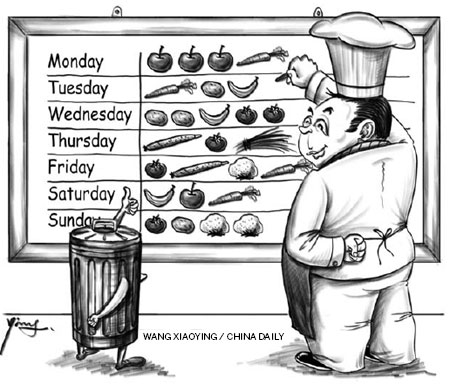
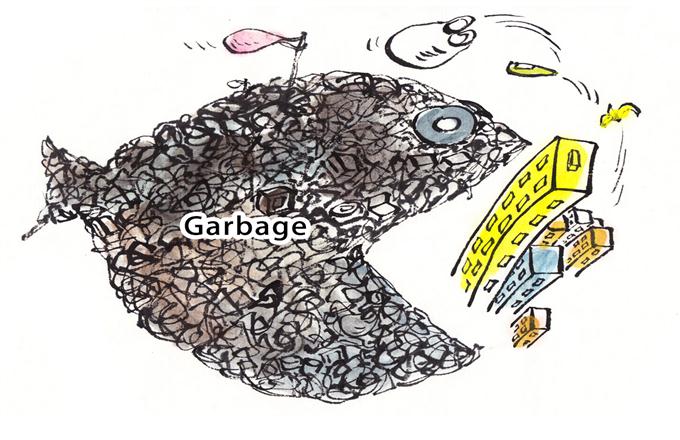
All of us should keep a kitchen diary, showing how much food leaves our home uneaten, as garbage. We all waste food, you and me, every day, millions of tons of it. In China, enough food is wasted in restaurants every year to feed 200 million people. In the United States, 40 percent of food is wasted from farm to fork. Each year, the amount of food thrown away in rich countries is almost the same as that produced in sub-Saharan Africa. This raises some important questions.
In developing countries, food is lost because farmers do not have appropriate cooling, storage or market access for their crops. Their grains, fruits and vegetables wither and rot away. In developed countries, the picture is different, and food is wasted in supermarkets, restaurants and at home. China faces both syndromes, significant losses in farms, as well as at the retail and consumption stages. And the amount of food wasted by Chinese consumers is rapidly increasing.
In China, which didn't have a supermarket until 1989, annual supermarket sales have reached $100 billion today. The country will soon become the biggest consumer market in the world.
Consumer culture has pervaded China and urban residents can get quality food from anywhere in the country and from across the planet. Chinese consumers are as picky about their food as their counterparts in other countries. In supermarkets, they refuse to buy vegetables that don't look fresh or have an irregular shape, or milk and other products close to their expiry date.
Besides, Chinese consumers tend to be generous. In restaurants or at home, often too much food is ordered or cooked and served. So while trooping out of a restaurant, full and happy, with colleagues or friends, look back at what's left untouched on the table. Should Chinese consumers take more responsibility for the waste they create?
Everyone deserves to have enough food to eat. Despite China's impressive success in reducing hunger over the past three decades, the job is not complete yet. Food security and diets in Chinese cities are way better than in its rural areas. About 12 percent of Chinese people are still undernourished, according to the UN Food and Agriculture Organization, which in itself is enough reason not to waste food. And there is more.
The world produces enough food to feed everyone on the planet. But the increasing demand and changed diets (more meat) threaten to exhaust the planet's natural resources, such as freshwater and land, and then there is climate change.
Mind you, the gasses emitted during food production are estimated to account for about 29 percent of the total gasses that are heating up our planet, probably much more. Livestock for our plate alone emits more greenhouse gasses (GHG) in carbon equivalents than cars, in the form of manure and digestive gasses, and more if land use is fully accounted for. The disposal of food waste is not just a lot of dirty and expensive work in big cities. Food waste is usually burned or dumped, contributing to climate change. Scientists say the 360,000 tons of milk wasted in the United Kingdom annually creates GHG emissions equivalent to 20,000 cars.
So what should Chinese consumers do? The most obvious thing for them to do is to stop throwing away food that is still edible. They should eat everything they buy and if they cannot, they should buy less. They should ask for smaller portions in stores, and smaller servings in restaurants and take home what they cannot finish. They should also check how much food they have before buying more and consume perishable items in which they buy them. If all the apples bought by urban households in Brazil, the US, India, Spain, the Philippines and the UK were eaten, 5.3 billion apples would be prevented from being wasted, enough to stretch more than nine times around the planet.
Even if Chinese people reduce their kitchen waste, a mass of organic and food waste for disposal in cities will remain. It is a systemic problem of today's urban consumerism. Separating kitchen (wet, organic) waste from other wastes helps, and in many countries, including China, large posters ask people to do so.
But consumers are not fools and should be taken seriously. A study conducted in Shanghai shows that although urban residents know how to separate waste, they do so only minimally. Why? Besides issues of smell and non-clarity, one of the main reasons for it is that sanitation authorities mix the separated waste during transportation. This defeats the purpose of waste separation in kitchens and discourages people from doing their share of the work.
Indeed, municipal waste systems should be capable of collecting and processing food waste separately and recycling it as fertilizer or animal feed. Technical capacity alone, however, is not enough to prevent food waste, and local governments are learning how to make people avoid and separate waste, Imposing charges for generating waste can be beneficiary in this regard.
Non-governmental organizations often invite consumers to show that they care. People should ask local authorities, supermarkets, restaurants and their favorite food brands how they are helping to reduce food waste in China. And teachers should be asked to pay attention to climate change, farming and responsible consumption to help create a healthier, more balanced society for all.
It all starts with care and curiosity. Start at home. Maintain a kitchen diary.
The author is manager of the Economic Justice, Policy and Campaign Unit of Oxfam Hong Kong in China.
(China Daily 03/05/2013 page10)