Disguise can't hide intent
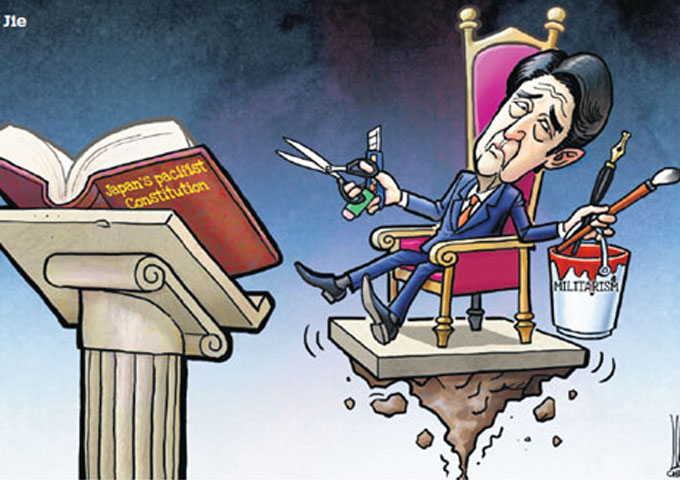
But recently, the Abe cabinet, especially the prime minister himself, has frequently hurt the feelings of people in the victimized countries by explicitly pursuing a historical revisionist line and trying to reverse the judgment on and beautify Japan's aggression against its neighbors. Abe has expressed open opposition to the Murayama Statement, which admitted that Japan invaded and occupied other countries, and he has questioned the legitimacy of Japan's post-war pacifist constitution, seeking to upgrade the country's Self-Defense Forces to a full-fledged military. He has denied there is an established definition of "aggression" and has made an offering at the notorious Yasukuni Shrine, where 14 Class-A war criminals are honored among Japan's war dead. While marking what the country calls "Sovereignty Day", Abe led the cry of "Long Live the Emperor" (which was used as a battle cry by Japanese troops). Abe's wrong words and actions transmit the message that Japan is completely turning right.
Encouraged by Abe's brazen revisionism, Taro Aso, Japan's deputy prime minister, and other cabinet ministers, and some 168 Japanese lawmakers visited the Yasukuni Shrine in April, the largest collective visit made by Japanese politicians in years. Moreover, Osaka Mayor and leader of the Japan Restoration Party Toru Hashimoto's improper comments about the women used as sexual slaves by Japanese military personnel during World War II also revealed the distorted values of right-wing Japanese politicians.
Abe's stubborn stance on Japan's militaristic past is in stark contrast with his high-profile pursuit of common values in the international arena and reveals a typical schizoid personality. Abe cabinet's retrograde actions suggest that it is attempting to challenge the results of World War II and the post-war international order.
Moreover, there is a real danger that the ultra-rightist force is growing stronger. In consideration of Abe cabinet's actions, there is every reason to question whether Abe is qualified to talk about democracy, freedom and human rights. Obviously, his so-called value-based diplomacy is just a political trick to fool the international community.
The international community should be on alert, as the Japanese ultra-rightists want to start a "new Cold War" in the name of value diplomacy.
Today, with the world becoming ever more multipolar and globalized, peace, development and cooperation have become an irreversible trend of the times. Countries in the world, big or small, are all in the same boat and should respect each other, carry out mutually beneficial cooperation and pursue common development. Any attempts to make artificial barriers and create tensions between countries go against the trend of the times.
However, the Abe cabinet is obviously moving against the tide in an attempt to split an increasingly integrated world by pursuing its so-called value-based diplomacy. In essence, this value diplomacy is a product of the Cold War mentality that aims to obliterate the diversity of development, dividing the world into diametrically opposed camps according to the similarities and differences in ideology, and political and social systems.
During the Cold War period, a security commitment from the United States enabled Japan to focus on economic development and it prospered during the Korean and the Vietnam wars. Within less than 20 years, Japan rose from the ruins of war to be the world's second-largest economy, becoming the main beneficiary of the Cold War. This unique experience has made the Japanese ruling class form a stubborn strategic inertia, and they are attempting to get countries with so-called common values to protect the vested interests gained during the Cold War period. Abe's diplomatic initiative might be attractive to some countries that are urgently seeking to develop their economies, as it has substantial financial and technical resources to offer.
At a time when global economic growth remains sluggish and international economic cooperation is facing a complex situation, the international community should be highly vigilant against Japanese ultra-rightists as they may hinder international solidarity and cooperation and threaten world peace.
Asian countries facing a historical development opportunity should be fully aware of the sinister intentions of Japan's ultra-rightists, consciously resist their attempts to split Asia and jointly safeguard the good momentum of regional win-win cooperation and common development.
The article first appeared in People's Daily.