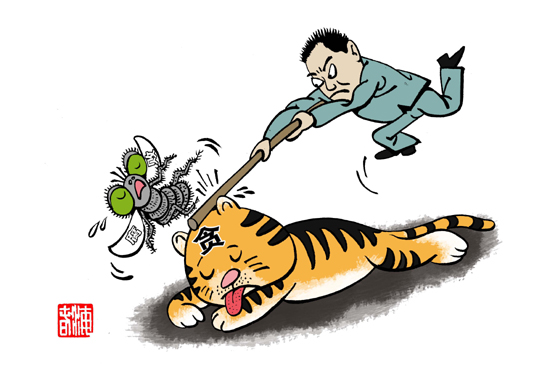
In general, China’s anti-corruption campaign has successively shifted from a mass movement and a leadership-directed practice that largely rest with power, to an institutionalized movement.
However, the “big tigers”, or major power abusers such as Zhou Yongkang, the country's former security chief, Xu Caihou, former vice-chairman of the Central Military Commission; and Ling Jihua, former minister of the United Front Work Department of the Communist Party of China Central Committee, had grown up despite the nation’s anti-corruption efforts with power and mechanism.
Since the 18th National Congress of the Communist Party of China in 2012, Chinese top leader Xi Jinping has reiterated the significance of “rule of law” in the country’s anti-graft efforts. And the Fourth Plenum of the 18th CPC Central Committee set up the goal of “governance according to the law”.
To better fight against corruption according to the law, governance according to the law should be the guideline in the nation’s massive anti-corruption campaign.
To fight against corruption according to the law has two meanings: First, laws should be primarily implemented to fight corruption. In other words, any lawbreaking graft will be unexceptionally punished according to law, and all punishments shall be equally based on certain standards. Second, to prevent latent corruption from taking shape, China legislates to restrict and regulate the use of public power.
The ongoing anti-graft movement in the country is even more powerful and widespread compared to that before the 18th Party Congress. So far, over 60 government officials at provincial and ministerial level or above have been placed under investigation, which shows anyone who is involved in corruption will be equally investigated and punished according to law.
It is thus fair to say that anti-corruption efforts according to law shall be the fundamental and comprehensive way to fight against corruption, in contrast to all previous forms of anti-graft practice based on the “rule of man”. Indeed, the combat against corruption is unlikely to succeed without complete legal norms.


I’ve lived in China for quite a considerable time including my graduate school years, travelled and worked in a few cities and still choose my destination taking into consideration the density of smog or PM2.5 particulate matter in the region.
Copyright 1995 - . All rights reserved. The content (including but not limited to text, photo, multimedia information, etc) published in this site belongs to China Daily Information Co (CDIC). Without written authorization from CDIC, such content shall not be republished or used in any form. Note: Browsers with 1024*768 or higher resolution are suggested for this site.
License for publishing multimedia online 0108263 Registration Number: 130349