 |
|
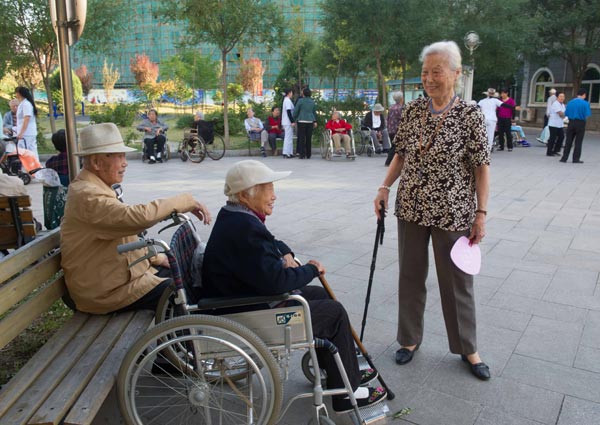
Senior citizens chat at a retirement home in Beijing. [Photo/Xinhua] |
The State Council, China's Cabinet, announced pension reforms for civil servants and public sector employees in Jan 2015, bringing them under the purview of the urban basic pension insurance scheme. The historic move signifies the abolition of the fragmented pension fund systems and the end of the privilege pension system for public sector.
Civil servants and public sector employees are mainly responsible for the smooth running of the State machinery. So, the pension reforms will not only help build a modern and more effective governance system, but also safeguard the interests of the nation's vital workforce by allowing them access to a pension scheme that is independent of the organizations they work for. The reforms will also protect their pensions irrespective of the changes that may occur in the future.
In addition, the reforms will help the movement of workforce between the public and private sectors by eliminating the different pension insurance schemes in the two sectors, and alleviate the fiscal risk arising from the aging population. The current dependency ratio of the urban employees' pension scheme is 3:1, that of public sector employees is 2.5:1 and civil servants 2:1. In this context, the reforms will promote social equality because the replacement rate of financially supported civil servants' and public sector employees' pension scheme is on average about twice that of employees in other enterprises.
However, the reforms will increase the burden of government organizations and public institutions as far as pension insurance contributions are concerned. The overall pension contributions by both employees and employers account for 40 percent of employees' salaries. Going by 2013 figures, fiscal expenditure for the first year would be as high as 800 billion yuan ($153.6 billion), which is equal to 6.2 percent of China's fiscal revenue and 1.4 percent of GDP. And we should not forget that this is just the expenditure on contributions of the basic pension (first tier) and occupational pension (second tier). It does not include the one-time yearly expenditure on retirees' personal accounts and occupational pension or the transitional pension established at the beginning of reform and opening-up. If we include these, the actual expenditure will exceed 1.1 trillion yuan.
The occupational pension system is necessary for reforming the pension system for civil servants and public sector employees, because it plays a key role in the "two-tier" pension system, without which the pension replacement rate cannot be guaranteed. For the enterprises in China, their complimentary occupational pension scheme follows a defined contribution pension plan, and the same should be adopted for the occupational pension scheme for civil servants and public sector employees.


I’ve lived in China for quite a considerable time including my graduate school years, travelled and worked in a few cities and still choose my destination taking into consideration the density of smog or PM2.5 particulate matter in the region.
Copyright 1995 - . All rights reserved. The content (including but not limited to text, photo, multimedia information, etc) published in this site belongs to China Daily Information Co (CDIC). Without written authorization from CDIC, such content shall not be republished or used in any form. Note: Browsers with 1024*768 or higher resolution are suggested for this site.
License for publishing multimedia online 0108263 Registration Number: 130349