 |
|
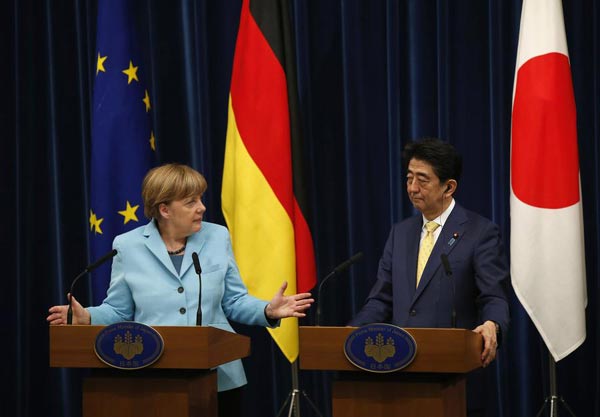
Germany's Chancellor Angela Merkel (L) and Japan's Prime Minister Shinzo Abe attend their joint news conference after talks at Abe's official residence in Tokyo, March 9, 2015. [Photo/Agencies] |
In her movingly beautiful novel dealing with Japan from the mid-1930s to the mid-1960s, The Gods of Heavenly Punishment, author Jennifer Cody Epstein describes how people tended to divide life between "before" and "after" the war.
When I was living in Japan in the 1950s, I remember the coinage and frequent usage of the term "apure" - which was derived from the French term après guerre and was meant to convey the mood of the "new" Japan after 1945.
But in his outstanding book, Year Zero: A History of 1945, Ian Buruma, writing on both the Atlantic and the Pacific Wars, demonstrated how things were not that simple.
As he shows, the closure of Auschwitz did not immediately result in the end of anti-Semitism in Germany or elsewhere in Europe.
Year Zero also covers in gruesome detail the atrocities committed by the Japanese in China - the mass rapes, the activities at Unit 731, in the then Japanese-occupied Northeast China, where vivisection was carried out on prisoners of war as part of biological and chemical warfare experiments.
There have been waves of water under the bridge in the past 70 years, though they have flowed quite differently in Europe and East Asia.
June 2014 marked the 70th anniversary of the Normandy D-Day landings. It was an emotional occasion, in which not only the heads of state and government of the allied nations, but also Angela Merkel of Germany participated. Similarly, veterans from both sides attended and embraced.
The 70th anniversary of the surrender of Germany and the end of the war in Europe on May 8 this year will no doubt reflect a similar spirit of reconciliation.
That history has been openly and collectively addressed for decades. When I was a doctoral student in the 1960s at St. Antony's College, Oxford, there were British, French and German researchers and scholars working together.
Dinner table discussion frequently turned to "what had happened". There is a basic consensus in Europe about the history of World War II and especially about the atrocities - the holocaust - committed by Germany. Erstwhile enemies are at peace, not because they have forgotten the past, but because they remember it.
The situation in the Pacific is different and alarming. Historical amnesia is never a good thing. In the famous words of George Santayana: "Those who cannot remember the past are condemned to repeat it."
The rejection of history is, quite understandably, especially associated with Japan. There is a combination of denial and willful ignorance. Ask a German about Auschwitz and he or she will almost certainly know. Ask a Japanese about Unit 731 (Nana-san-ichi Butai in Japanese) and he or she will almost certainly not know.
Japan invaded every East Asian country except Thailand in the course of the Pacific War, although today many Japanese arriving in, say, Singapore, Malaysia, the Philippines, Myanmar or Indonesia, hear about it - if they do at all - for the first time.


I’ve lived in China for quite a considerable time including my graduate school years, travelled and worked in a few cities and still choose my destination taking into consideration the density of smog or PM2.5 particulate matter in the region.
Copyright 1995 - . All rights reserved. The content (including but not limited to text, photo, multimedia information, etc) published in this site belongs to China Daily Information Co (CDIC). Without written authorization from CDIC, such content shall not be republished or used in any form. Note: Browsers with 1024*768 or higher resolution are suggested for this site.
License for publishing multimedia online 0108263 Registration Number: 130349