 |
|
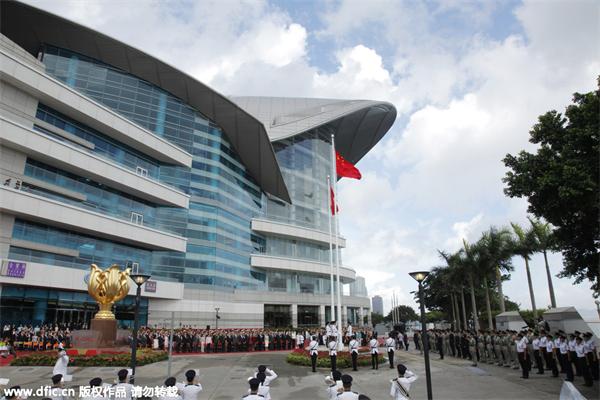
Hong Kong government officials and other participants attend a flag-raising ceremony at Golden Bauhinia Square to celebrate the 16th anniversary of the establishment of the Hong Kong Special Administrative Region (Hong Kong SAR) in Hong Kong, China, 1 July 2013. |
This year is the 25th year of the mandate of the Basic Law of the Hong Kong Special Administrative Region, although it went into effect only on July 1, 1997. Representing the spirit of the "One Country, Two Systems" principle, the Basic Law has played a key role both in Hong Kong's return to China and in giving it a high degree of autonomy in internal affairs.
Thanks to the reform and opening-up, the Standing Committee of the National People's Congress, the top legislature, approved the Basic Law of Hong Kong on April 4, 1990, legally confirming the political idea of "One Country, Two Systems" and strengthening national unity.
The Basic Law also shows the central government is not only determined to break the ideological restrictions to deepen reform and opening up, but also prepared to manage a region with a different political system with tolerance. It is the central leadership's faith in the socialist system that made this possible. And because of this faith, it has been reiterating that the "One Country, Two Systems" principle will not and cannot be changed. No wonder, "strictly adhering to the Basic Law" is the principle followed by every central official dealing with Hong Kong-related affairs.
The Hong Kong SAR has played a very important role in China's rapid economic development, which again can be attributed to the honest and strict implementation of the Basic Law.
Nevertheless, some people in Hong Kong are making "noises" against the implementation of the "One Country, Two Systems" principle, which conforms to the Basic Law. Of course, the opposing voices confirm the fact that individual freedom is highly respected in Hong Kong.
Concurrently, they also show that some Hong Kong residents still cannot understand the "One Country, Two Systems" principle because they are reluctant to accept the political relationship between the central government and Hong Kong. Such people have to be reminded to view the "One Country, Two Systems" principle in the right, that is, national perspective. They cannot focus on the "two systems" and conveniently ignore the "one country" part of the principle, because the latter is the foundation of the former.
Hong Kong is a special administrative region, but it is part of China. This means the central government has a say in Hong Kong's political development. But some Hong Kong residents have challenged the central government's authority. They even launched the "Occupy Central" movement last year that lasted 79 days and caused huge economic losses to the SAR. Hong Kong's pan-democracy camp even threatened to vote down Hong Kong government's political reform plan in the Legislative Council.
On Aug 31, 2014, the NPC Standing Committee announced its decision on universal suffrage in the Hong Kong chief executive's election. By deciding that the chief executive should be elected only after being nominated by a "broadly representative committee", the NPC Standing Committee has honored its political promise to deal with Hong Kong's political development according to the rule of law. And the pan-democracy camp has to accept the central government's authority in Hong Kong's political development.
Hong Kong is a mature society that respects the rule of law. So instead of pushing Hong Kong's political reform toward a dead-end, the pan-democracy camp should follow the Basic Law and respect Hong Kong residents' appeal to adopt a pragmatic approach to the issue.
The "One Country, Two Systems" principle is a long-term basic State policy. And only when the Basic Law that represents the spirit of the principle is fully respected can it be well implemented.
The author is a professor at Shenzhen University and a member of the Chinese Association of Hong Kong and Macao Studies.


I’ve lived in China for quite a considerable time including my graduate school years, travelled and worked in a few cities and still choose my destination taking into consideration the density of smog or PM2.5 particulate matter in the region.
Copyright 1995 - . All rights reserved. The content (including but not limited to text, photo, multimedia information, etc) published in this site belongs to China Daily Information Co (CDIC). Without written authorization from CDIC, such content shall not be republished or used in any form. Note: Browsers with 1024*768 or higher resolution are suggested for this site.
License for publishing multimedia online 0108263 Registration Number: 130349