 |
|
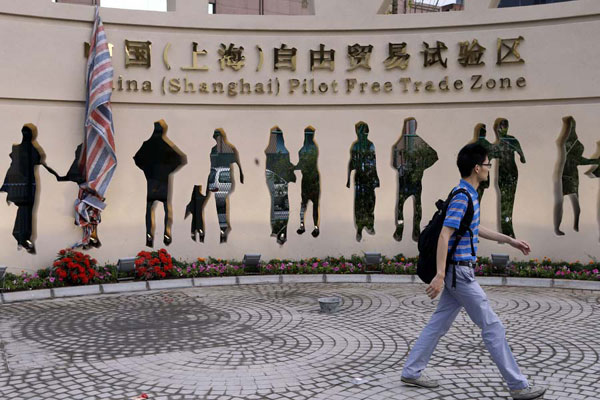
The name plate of the China (Shanghai) Pilot Free Trade Zone on a gate of the Waigaoqiao free trade zone in Shanghai. [Zhao Yun / For China Daily] |
The Asia-Pacific region is expected to remain the world's growth leader. This contrasts with the global economic landscape, where growth remains uneven against a backdrop of continued low oil prices, sharp variations in exchange rates of major currencies and potential financial market volatility.
Growth in the region is expected to hold steady at 5.6 percent in 2015, easing slightly to 5.5 percent in 2016. Domestic demand is forecast to remain strong, supported by healthy labor market conditions, historically low interest rates and low oil prices. Exports will continue to benefit from the recovery in advanced economies and weaker exchange rates in some economies, despite the slowdown in some major emerging markets and the trend decline in exports' responsiveness to partner country demand, reflecting greater on-shoring of production.
The growth momentum in the largest Asia-Pacific economies, while good overall, is expected to remain mixed. China's economy is gradually slowing to a more sustainable pace, with GDP projected to increase by 6.8 percent in 2015 and 6.3 percent in 2016 as the orderly correction in the residential real estate sector is expected to compress real estate investment. Slowing activity, in part, reflects progress in reducing vulnerabilities.
Japan's growth is expected to recover to 1.0 percent in 2015 and 1.2 percent in 2016, buoyed by consumption and exports. And thanks to recent policy reforms and lower oil prices, India will be one of the fastest growing major economies, expanding by 7.5 percent in 2015 and 2016.
Sharp exchange rate swings in advanced economies, partly reflecting divergent monetary policies, are also being felt in the Asia-Pacific. While commodity exporters in Asia have seen their currencies depreciate sharply against the US dollar, other currencies have weakened by considerably less or remained stable. These diverse exchange rate movements may create a dilemma for some policymakers seeking to balance competitiveness considerations with financial stability concerns arising from the buildup of foreign currency-denominated debt during the past few years.
However, downside risks could cloud this benign regional outlook. Lower-than-expected growth in China and Japan could spill over to other economies. Volatile global financial conditions could be disruptive, particularly where debt levels are high.
On the upside, lower energy prices could boost growth while also creating room for fiscal reforms. For China, the near-term hard-landing risk is considered low. And the main downside risks will be inadequate progress in advancing reforms and containing vulnerabilities, which could lead to a sharp correction over the medium term.
Given the wide diversity across the region, no "one size fits all" advice holds. In general, current settings for policy interest rates are broadly appropriate given prevailing economic conditions and inflation rates.
But going forward, higher policy rates may be needed in some cases in the event of capital flow reversals to reinforce external stability. In Japan, where interest rates are already close to zero, aggressive stimulus through quantitative and qualitative easing should continue in order to achieve positive inflation on a durable basis, accompanied by progress on structural reforms.
In countries where public and private debt is high, gradual fiscal consolidation would strengthen resilience. The decline in oil and food prices provides an opportunity to phase out budget subsidies and make room for infrastructure and social spending, including on health and education that can also help reduce income inequality. Macro-prudential policies should address financial stability risks, and foreign exchange intervention could be considered to smooth excessive currency volatility.
Potential growth has slowed across much of Asia, reflecting primarily decelerating total factor productivity, which may be attributed in part to slowing gains from participating in global value chains.
Over the medium term, Asia would also benefit from deeper intra-regional financial integration, which has lagged trade integration. China's planned financial sector reforms and a further opening-up of the economy will go a long way towards allocating resources more efficiently to spur new sources of growth and facilitate financial integration both with Asia and the rest of the world. But these reforms need to be well sequenced and supported through further strengthening of policy frameworks, including continued progress in financial regulation and supervision.
Alfred Schipke is the IMF's senior resident representative and Raphael Lam deputy resident representative for China.


I’ve lived in China for quite a considerable time including my graduate school years, travelled and worked in a few cities and still choose my destination taking into consideration the density of smog or PM2.5 particulate matter in the region.
Copyright 1995 - . All rights reserved. The content (including but not limited to text, photo, multimedia information, etc) published in this site belongs to China Daily Information Co (CDIC). Without written authorization from CDIC, such content shall not be republished or used in any form. Note: Browsers with 1024*768 or higher resolution are suggested for this site.
License for publishing multimedia online 0108263 Registration Number: 130349