 |
|
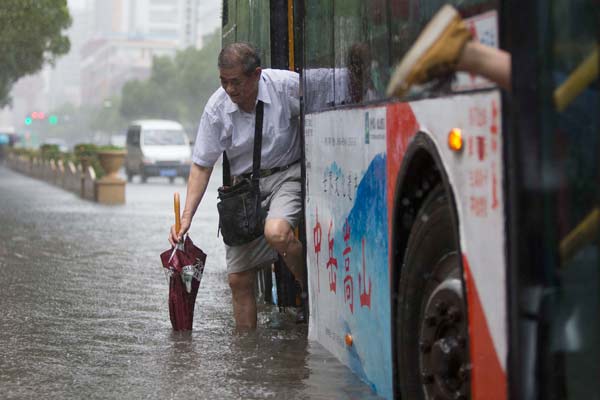
Downpours seriously disrupt traffic in Nanjing, capital of Jiangsu province.Song Qiao / For China Daily |
Water as a resource is irreplaceable. Yet heavy rainfall can become a disaster even in modern cities if rainwater is not drained out in time. This was recently evident in Shanghai, Nanjing and some other cities, especially in southern China, where streets looked more like the canals of Venice.
The idea of "sponge city", which emerged in the West and is gradually gaining popularity in China, will hopefully solve this problem. Following the philosophy of "solving a city's problems with its own resources", it aims at storing rainwater, especially during heavy rainfall, to prevent floods and release it for the benefit of residents during dry times. This will also ease a city's water shortage.
The water distributive system has three main parts. First, it encourages the cultivation of "wetlands" and "meadows" in urban gardens, which will help collect water in pools, enable trees and plants to hold water, and replenish the underground water table. In case of water shortage, the water in the pools can be used directly, while more plants mean higher humidity and evaporation which will eventually lead to higher precipitation levels.
Second, buildings can collect rainwater, recycle it and save it in tanks or underground reservoirs. Data show that if all the prominent buildings in a city install a system to recycle and save rainfall, the rate of water flowing to the ground during heavy rainfall and thunderstorms could drop by 80 percent.
And third, a sponge community will combine pools, urban "meadows" and "wetlands", and sponge buildings within one whole system. This is a particularly beneficial idea for China which has a tradition of living with nature - gardens are considered an indispensable part of traditional Chinese architecture. Pools, open green spaces and trees are key elements of traditional Chinese compounds, all of which help save water.
Sponge cities save water and, therefore, are more environmentally friendly. Some cities in foreign countries have not only adopted the idea of sponge gardens, but also built sponge squares. Unlike metaled squares that prevent water from replenishing the underground water table, these sponge squares have plants and well-designed pipelines that help store large volumes of water under the Earth's surface. Chinese cities too can benefit by changing its metaled or tile-bedded squares to sponge squares.
Sponge cities will also reduce pollution. Studies show that rainwater flow in the first 30 minutes is exceptionally muddy because it carries the dust from buildings and roads. The mud, considered a waste by humans, is good nutrition for plants and meadows. Trees, plants and grass filter absorb the mud and thus filter the water that flows to the underground water table. And good rainfall helps cities save piped water that they use to clean the streets.
In more ways than one a sponge city will be a smart city. Urban management officials can install devices across a city to collect real data on rainfall, ground and underground flow of water, and amount of pollutants, which they can use to deal with emergencies.
A sponge city follows the philosophy of innovation: that a city can solve water problems instead of creating them. In the long run, sponge cities will reduce carbon emission cities and help fight climate change. The idea of green cities will rule in the future and sponge cities will be part of it.
The author is counselor of the State Council and former vice-minister of Housing and Urban-Rural Development. This is an excerpt from a speech he delivered at the recent International Low Carbon City forum in Shenzhen, Guangdong province.


I’ve lived in China for quite a considerable time including my graduate school years, travelled and worked in a few cities and still choose my destination taking into consideration the density of smog or PM2.5 particulate matter in the region.
Copyright 1995 - . All rights reserved. The content (including but not limited to text, photo, multimedia information, etc) published in this site belongs to China Daily Information Co (CDIC). Without written authorization from CDIC, such content shall not be republished or used in any form. Note: Browsers with 1024*768 or higher resolution are suggested for this site.
License for publishing multimedia online 0108263 Registration Number: 130349