 |
|
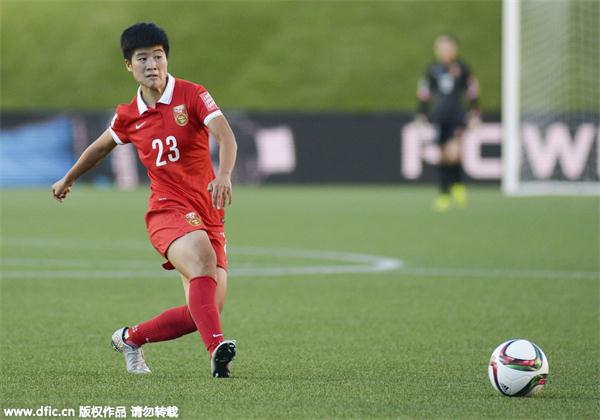
Ren Guixin (#23) of China during the FIFA 2015 women's World Cup Quarter-Final match between China and the USA at Lansdowne Stadium in Ottawa, Canada. [Photo/IC] |
On June 26, when the American and Chinese women's teams faced each other in the semi-finals in the Football World Cup, it brought back memories of the last time they faced each other in the World Cup: the 1999 final in the United States. Then, after a scoreless game, the US won 5-4 on penalty kicks. This time, the US won 1-0 after a hard-fought game. The two games reflect not just how women's soccer has changed in the last 16 years, but also how China, the US and their relationship have changed.
Earlier, for Chinese fans, sports was the only area in which their country was able to compete with the world powers, and sporting success was linked with patriotism. The fact that most of the early successes were achieved by women did not matter much in the era when the public craved any kind of international recognition. With women's soccer being a new sport, the government-supported equality of the sexes enabled China to excel, a strategy that paid off over the years in many newly created women's events. China's early edge faded over time, as the world-wide participation of women expanded rapidly over the years.
Fast forward to 2015. The US-China rivalry is no longer new. Chinese patriots can now be proud of their achievements in many areas besides sports. However, attempts to wean sports off government support has had limited success. Corporate sponsorship was slow to take off because of the lack of a Western-style sports culture, and stringent registration procedures for non-governmental organizations discouraged the formation of sports clubs.
The focus on written examinations and the strict family planning policy produced a single-minded focus on children's academic studies to the detriment of school sports. With non-profit clubs and schools-the two most likely avenues for the development of sports at the grassroots level-closed off, the only athletes with access to high-level coaches and facilities were those on State-supported teams.
We can compare the numbers of female soccer players in the Chinese and US development pipeline by looking at the number of players in China's national and provincial teams and in the US National Collegiate Athletic Association Division I soccer teams. Both serve as the training grounds for their respective national teams' players. In 1999, China had 3,017 male and female football players in the pipeline, while the NCAA Division I had 6,150 female soccer players in 251 teams. In 2013, China had 1,389 female players, while the US number had increased to 8,843 in 325 teams. The number of Chinese teams has stayed steady around 30 because the numbers of provinces have not increased; in fact, only about 15 of the wealthier provinces and municipalities produce athletes who rise to national and world levels.
In sum, even though the US population is one-fourth that of China's, it has more than four times as many female soccer players in high-level training. Even these numbers do not tell the whole story, because NCAA Division I soccer is only the small tip of a much bigger pyramid. Divisions I, II and III combined have more than 26,000 female soccer players. In high school teams there are nearly 380,000 girls. In US Youth Soccer, there are some 1.5 million girls. In the Chinese system, the next rung down the pyramid after the provincial and national teams consists of athletes overseen by local sports commissions. Based on the last published figure in 2009, if we generously assume that half of the registered soccer players were female, then their number would be 9,600.
China's sports system has lagged behind the developed world in its attention to pleasure and quality of life, as seen in areas such as environmental degradation, the underdevelopment of consumerism, and fact that the General Administration for Sports paid almost no attention to popular recreation. But increasingly Chinese people are demanding opportunities for popular recreation.
The author is professor of Anthropology, University of Missouri-St. Louis.
Courtesy: China &US Focus


I’ve lived in China for quite a considerable time including my graduate school years, travelled and worked in a few cities and still choose my destination taking into consideration the density of smog or PM2.5 particulate matter in the region.
Copyright 1995 - . All rights reserved. The content (including but not limited to text, photo, multimedia information, etc) published in this site belongs to China Daily Information Co (CDIC). Without written authorization from CDIC, such content shall not be republished or used in any form. Note: Browsers with 1024*768 or higher resolution are suggested for this site.
License for publishing multimedia online 0108263 Registration Number: 130349