 |
|
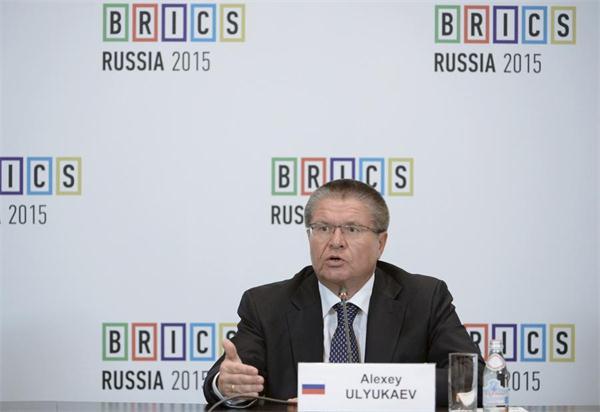
Russian Economy Minister Alexei Ulyukayev attends a news conference after a meeting of the BRICS finance and trade ministers in Moscow, Russia, July 7, 2015. [Photo/Agencies] |
Russian President Vladimir Putin will host two important international summits, one of the BRICS group on July 8-9 and the other of Shanghai Cooperation Organizations members on July 9-10.
For public relations, this will allow him to send a message to the world that despite the rupture with Europe and a new "standoff" with the United States, Russia is anything but isolated. With leaders of China, India, Brazil, Pakistan, South Africa, Iran and several other countries in attendance, together representing roughly half of the world's population, Putin will be able to project an image of Russia joining the global "new wave" of non-Western countries raising their profile and expanding their role in the world.
This is a sea change for Russia's foreign policy. Since the disintegration of the Soviet Union, Russia has had two strategies, one official and the other held in reserve. The official strategy was aimed at integrating Russia, on its own terms, into the Euro-Atlantic community, i.e. expanded West. The G8 membership symbolized that. The other was to integrate former Soviet republics into a full-fledged Eurasian Union: an economic, political, and security alliance, a Moscow-led power center in Eurasia.
Today, the first strategy is a complete failure; the second one, limited to economics and without Ukraine, qualifies as only a most moderate success.
Under these circumstances, reaching out pro-actively to the non-West is the only realistic option for Moscow. To exercise it, it will need to reform its traditional Western-centric worldview and pay more attention to its neighbors in Asia, and partners across the global South. For that, Moscow will not only need to learn more about them, and about their ways of doing business, but also to treat them as peers. Expanding economic relations, strengthening cultural ties and deepening understanding among the members of elite groups emerge as clear priorities.
On top of the list is China. The relationship with Beijing is emerging as Moscow's most important one, ahead of those with Washington and Berlin. Getting that relationship right - in the face of the obvious disparities between Russia and China - will be crucial for the future of Russia as a great power. Russia recently joined the Asian Infrastructure Investment Bank and has moved to "harmonize" the Eurasian Economic Union with the Silk Road Economic Belt. The SCO can now serve as both a platform and a vehicle for Sino-Russian economic harmonization.
With India and Pakistan seeking to join the SCO, and Iran drawing closer, the organization is becoming more diverse and will have to have a clear focus in order to become something more than a series of regular meetings. Creating a common Eurasian economic space is one headline goal. Working toward a common security arrangement for Continental Asia - building on the original purpose of the Shanghai Five as it was called in the 1990s - is another. Building lasting partnerships and enhancing trust among its member states is a third strategic objective.
As for BRICS, besides the function of promoting its members' interests in the world of global finance and advancing other elements of the global agenda, it could become a model of the global order writ large. The things that its members are publicly preaching, such as sovereignty and non-interference, equality and justice, and rights rooted in responsibilities, can and should be practiced in relations among these countries themselves. There is nothing more compelling than leading by one's own example.
The new world order will not come through the overthrow of the existing US-dominated system, but by means of the triumph of the global best practices. If the leading countries of the non-West can come up with viable alternatives to established ways of doing business in the world, they will make a difference. To succeed in this, they will need to treat their own institution building as anything but an exercise in anti-Western exploits.
Russia, as the host of the two summits, should view its role as an economic resource base, a diplomatic adviser and a defense arsenal of the emerging community of the non-West. It has to rise to the occasion.
The author is director of the Carnegie Moscow Center.


I’ve lived in China for quite a considerable time including my graduate school years, travelled and worked in a few cities and still choose my destination taking into consideration the density of smog or PM2.5 particulate matter in the region.
Copyright 1995 - . All rights reserved. The content (including but not limited to text, photo, multimedia information, etc) published in this site belongs to China Daily Information Co (CDIC). Without written authorization from CDIC, such content shall not be republished or used in any form. Note: Browsers with 1024*768 or higher resolution are suggested for this site.
License for publishing multimedia online 0108263 Registration Number: 130349