 |
|
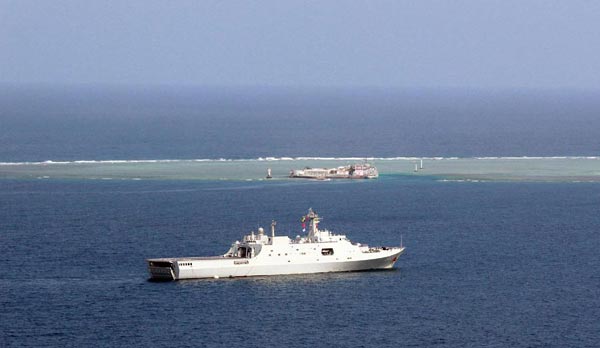
China firmly upholds her sovereignty and maritime rights and interests in the South China Sea. [Photo/Xinhua] |
A tribunal established at the request of the Philippines is currently holding hearings at The Hague to examine its jurisdiction in the South China Sea Arbitration (the Philippines v. China).
Previously the Chinese government has declared its policy of not accepting or participating in the proceedings and published the Position Paper of the Government of the People's Republic of China on the Matter of Jurisdiction in the South China Sea Arbitration Initiated by the Republic of the Philippines on Dec 7, 2014 to elaborate its position that the Tribunal manifestly has no jurisdiction.
For a long time a dispute has existed between the Philippines and China in the South China Sea in respect of sovereignty over some islands and certain delimitation matters. The Philippines unilaterally initiated in 2013 compulsory arbitration against China on the basis of Part XV of the United Nations Convention on the Law of the Sea (UNCLOS). It "skilfully" fragments the dispute with China into various free-standing-appearing entitlement claims, which are pre-delimitation matters, and activities claims, which are post-delimitation matters, while steadfastly avoiding sovereignty and delimitation. Its Statement of Claim presents 10 claims in this fashion, trying to bring the dispute under the application and interpretation of UNCLOS. However "skillful", the Philippines' fragmentation magic cannot conceal the sovereignty-delimitation nature of the dispute.
Part XV of UNCLOS does address dispute settlement. It first permits State parties to freely choose any means of dispute settlement and/or exclude any. The Philippines and China through the combination of a series of bilateral declarations and the multilateral Declaration on the Conduct of Parties in the South China Sea have reached agreement on settling all their disputes in the South China Sea only through negotiations. For example, a 1995 joint statement proclaims that "a gradual and progressive process of cooperation shall be adopted with a view to eventually negotiating a settlement of the bilateral disputes". The phrase "eventually negotiating" clearly evinces the intent to choose only "negotiations" as the means of dispute settlement and to exclude all other means. As a result, the tribunal has no jurisdiction. In any event, the two States have not engaged in any negotiation on setting the dispute, the discussions being on situational management. Thus the jurisdictional condition for resorting to compulsory arbitration has not been met.
Part XV is not a general dispute settlement clause, but provides for settlement of only disputes concerning the interpretation or application of UNCLOS and Article 288(1) limits the jurisdiction of compulsory procedures to such disputes. As the Convention, its drafting history and international case law such as the Mauritius v. United Kingdom Arbitration make clear, disputes on land territorial sovereignty are not such disputes, and are not subject to UNCLOS.
Here the dispute presented by the Philippines constitutes, at its core, a land territorial sovereignty dispute. Many statements made by Philippine officials, heavily emphasizing territory and sovereignty, attest to this point. In any event, the resolution of the dispute would constitute a decision on the sovereignty over many islands or insular features, or necessarily involve the concurrent consideration of unsettled disputes concerning sovereignty or other rights over these islands or insular features including China's archipelagos and/or Taiping Dao (Itu Aba Island) or Zhongye Dao (Thitu Island), or depend on a decision on the sovereignty over them. A decision relating to any feature at issue would have the effect of chopping a chunk off Zhongsha Qundao (as far as Huangyan Dao is concerned) or Nansha Qundao (as far as other features are concerned) and deciding on the status of such a chunk in isolation. Further, such a decision would also have the effect of denying China's sovereignty over other islands from which China's entitlement projection extend over the features at issue.


I’ve lived in China for quite a considerable time including my graduate school years, travelled and worked in a few cities and still choose my destination taking into consideration the density of smog or PM2.5 particulate matter in the region.
Copyright 1995 - . All rights reserved. The content (including but not limited to text, photo, multimedia information, etc) published in this site belongs to China Daily Information Co (CDIC). Without written authorization from CDIC, such content shall not be republished or used in any form. Note: Browsers with 1024*768 or higher resolution are suggested for this site.
License for publishing multimedia online 0108263 Registration Number: 130349