 |
|
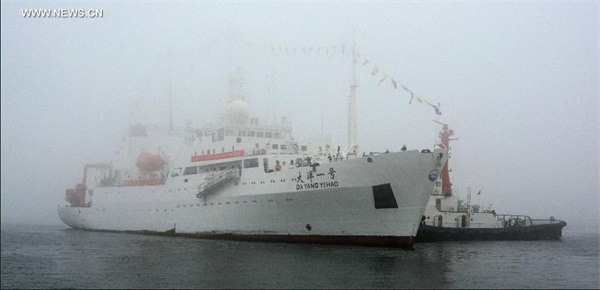
The Chinese research vessel Dayang Yihao (Ocean No. 1) returns to its base port after finishing a 215-day exploration of the Indian Ocean in Qingdao, east China's Shandong Province, June 18, 2015. During the 25,628-nautical mile voyage in China's 34th oceanic expedition mission, researchers on board the vessel explored the polymetallic sulfide resources on the sea bed. [Xinhua/Zhang Xudong] |
Whenever a Chinese submarine appears in the waters of the Indian Ocean, India's media react immediately. In June, a leading Indian newspaper said a Chinese conventional Yuan-class submarine had entered the Karachi port for replenishment. Indian Navy Chief Admiral Robin Dhowan was quoted as saying his force was "minutely and continuously monitoring" the presence of Chinese warships in the region to ascertain "what challenges they could pose for us".
When a Chinese submarine anchored in Colombo last September, rumors had it that the Indian government had warned the Sri Lankan government that this shouldn't happen again.
This is most unfortunate. Chinese submarines in the Indian Ocean are no secret. In fact, they passed visibly through the Strait of Malacca with other Chinese naval ships sailing to the Gulf of Aden. Some in India argue that anti-piracy doesn't need a submarine and China is practicing long-range deployments of its nuclear and conventional submarines on the pretext of anti-piracy.
However, in 2010, a Dutch submarine under NATO command was deployed to combat piracy off the east coast of Africa. The submarine was used to monitor communications between pirate vessels and their warlords on shore.
But even if Chinese naval ships and submarines appear regularly in the Indian Ocean, so what? Ninety percent of world trade is maritime trade. As the largest trading nation in the world, maritime security in the Indo-Pacific cannot be more important for China. The Chinese navy has to protect its overseas interests such as the safety of personnel and security of property and investment. Much of these are along the rim of the Indian Ocean. As one of the largest oil importers itself, India should have better understanding, say, of the energy needs of China and China's concern over the sea lane in the Indian Ocean. Four-fifths of China's oil imports pass through the area.
India alone cannot assure the security of the Indian Ocean, even if it regards the Indian Ocean as its backyard and wishes no one to compete with it there. This is why counter-piracy has involved navies from more than 20 countries, including China and India. China is not jostling with India for strategic influence in the Indian Ocean.
The likelihood of a naval clash between the two navies in the Indian Ocean, as some Indian strategists have suggested, cannot be more hypothetical. If there can't be an all-out war between China and India, how can the Chinese and Indian navies have war at sea? And if the disputed border has remained peaceful for more than half a century, how can anyone prove that the two countries are going to have a war at all?
Since 2000 the Chinese and Indian navies have had quite a few reciprocal visits. These visits are part of the exchanges between the two militaries which mirror the growing understanding, if not rapprochement, between the two sides. The Indian navy is not unfamiliar with Chinese waters: it has sent ships to attend fleet reviews in China in 2009 and 2014. As a token of good gesture, it has invited the Chinese navy to attend international fleet review in India in 2016.
Maybe one day the submarines of the two countries could also visit each other? Even the most advanced Chinese conventional submarines have received foreign visitors. If a Chinese submarine's visit to India is still a taboo, probably an Indian submarine can be invited to visit China and dock at a Chinese naval base first.
India, like China, is growing with strength. If growth of strength indeed brings confidence, a stronger India should be broad-minded. The Chinese naval vessels in the international waters of the Indian Ocean should not be taken as a threat. If the Pacific Ocean is big enough to accommodate China and the US, so is the Indian Ocean to accommodate India and China.
The author is an honorary fellow with Center of China-American Defense Relations of Beijing-based Academy of Military Science.


I’ve lived in China for quite a considerable time including my graduate school years, travelled and worked in a few cities and still choose my destination taking into consideration the density of smog or PM2.5 particulate matter in the region.
Copyright 1995 - . All rights reserved. The content (including but not limited to text, photo, multimedia information, etc) published in this site belongs to China Daily Information Co (CDIC). Without written authorization from CDIC, such content shall not be republished or used in any form. Note: Browsers with 1024*768 or higher resolution are suggested for this site.
License for publishing multimedia online 0108263 Registration Number: 130349