 |
|
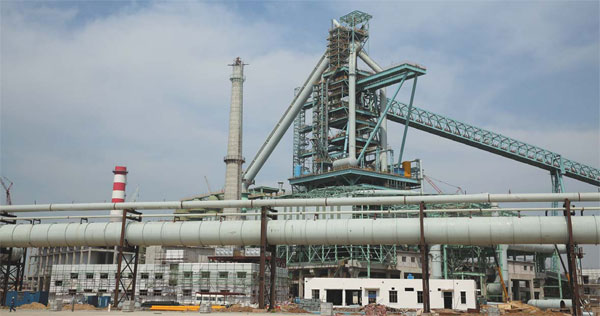
Baosteel Group, the largest steelmaker in China, vows to make breakthroughs in energy saving and environmental protection at its new complex in Zhanjiang, Guangdong province. |
China faces a fundamental challenge: How to balance environment protection with economic growth? Environmental protection can yield huge social benefits in terms of health and natural resources. But there is often an accompanying price to pay - in terms of jobs as well as the costs of compliance with tighter regulations. Achieving the right balance means addressing a complex set of factors causing environmental degradation.
The efficiency of the China's industrial sector is low in terms of carbon emissions, pollution and resource intensities. Take carbon emissions for instance. China's carbon emissions per dollar of GDP are more than three times that of Japan. Why is this the case? Clearly, a major factor is the fact that there is still huge reliance on coal to meet energy needs. And the rapid urbanization is not being planned in a "green" manner. Overall, there needs to be a concerted effort to promote a new industrial base and a shift away from a fossil fuel-intensive heavy industry toward a low-carbon model. The result will otherwise be low efficiency and rising pollution.
The Chinese government recognizes these challenges and is mobilizing public and private resources. On June 30, Premier Li Keqiang said China has submitted to the United Nations a detailed set of measures and targets to achieve a low-carbon economy. For example, the government has committed itself to cutting by 2030 carbon dioxide emissions per GDP between 60 to 65 percent of their 2005 level. It has also pledged that by 2030 non-fossil sources of energy will account for 20 percent of the primary energy mix from 11.2 percent last year, and forest stock will be increased by 4.5 billion cubic meters compared with 2005 levels.
While we (at the Asian Development Bank) applaud the Chinese government for these targets, the ADB recently presented to the China Council for International Cooperation on Environment and Development five major recommendations to accelerate the process.
First, more ambitious climate change mitigation targets may be attainable by 2030 or even earlier. These include capping energy consumption at 4.6 billion to 4.8 billion tons of coal equivalent, restricting coal to about 60 percent of the energy mix from 64.2 percent last year, and raising non-fossil and renewable sources to at least 15 percent, all by 2020.
Second, the Environmental Protection Law needs to be better enforced, including strengthening the environmental courts, increasing their number, and clarifying legal rights to boost public access to the legal system. Court and environmental protection bureau decisions must be fully implemented by all arms of local governments.
Third, severe air pollution in the Beijing-Tianjin-Hebei area underscores the need for regional planning and cross-sector coordination. Regional coordination mechanisms should be established for joint pollution control, monitoring and enforcement.
Fourth, there needs to be a shift toward economic instruments, most notably a series of environmental taxes on major pollutants. China has just published a draft law on environmental taxes to reduce pollution in key industries. It is important to ensure that the taxes are set at levels that provide adequate incentives for industries to invest in pollution control. Other important measures would include introducing a carbon tax and natural resources tax, and allowing tax deductions to offset investments in pollution-control equipment. And last, new revenue from environmental and natural resource taxes should be shared with local governments to encourage investment in environmental protection and resource conservation.
The ADB will continue to give full support to China and its people in addressing the "twin challenge" of the environment and climate change, while promoting greater industrial efficiency and technological transformation. In doing so, the country needs to develop an engine of green growth that can power its ambitious vision of an "ecological civilization". Success is not only critically important to the country's citizens, but to the wider global community as we address the threat of climate change.
The author is vice-president of the Asian Development Bank.


I’ve lived in China for quite a considerable time including my graduate school years, travelled and worked in a few cities and still choose my destination taking into consideration the density of smog or PM2.5 particulate matter in the region.
Copyright 1995 - . All rights reserved. The content (including but not limited to text, photo, multimedia information, etc) published in this site belongs to China Daily Information Co (CDIC). Without written authorization from CDIC, such content shall not be republished or used in any form. Note: Browsers with 1024*768 or higher resolution are suggested for this site.
License for publishing multimedia online 0108263 Registration Number: 130349