 |
|
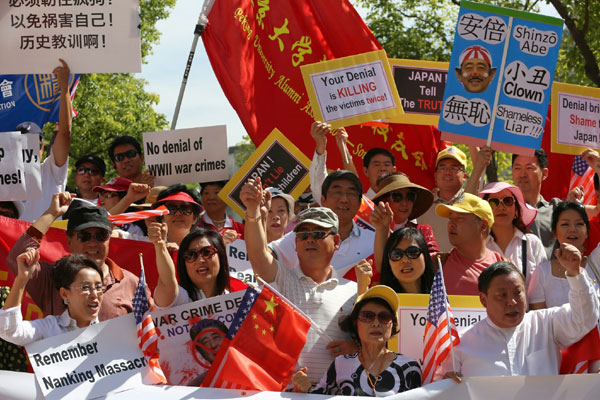
Hundreds of protesters rally on May 1 near the Millennium Biltmore Hotel in Los Angeles where Japanese Prime Minister Shinzo Abe was scheduled to attend a luncheon. They demanded that Abe apologize for Japan's wartime wrongdoings. Provided to China Daily. |
For the last seven decades, Japan has been a rather inward looking nation, not much engaged either with its neighbors or the world beyond in other than purely economic concerns: trade and outward foreign direct investment.
Beyond the purely economic dimensions, Japan cannot claim to have been an active Asian, let alone global citizen. Indeed, in many ways Japan has remained closed to its neighbors. The so-called Asian NIEs (newly industrialized economies) were able to achieve export-driven growth by penetrating, and profiting from, American and European markets, not that of their rich neighbor Japan.
This is one of the many differences between Germany and Japan. Germany has been the major market for its European neighbors, including the emerging East European economies. In contrast, Japan has not played the role of a regional economic locomotive.
The other major difference between Germany and Japan is that, while the former has atoned for its atrocities and has reconciled peacefully with its neighbors, Japan has not.
The fact that Japan should be redefining its military role raises many questions, especially because of the way two security bills were railroaded through parliament. Polls indicate that two-thirds of the Japanese people are opposed to the bills. There have been demonstrations and petitions against them in Japan.
Fundamentally, however, the fact that Japan has not been an active Asian citizen would not have per se caused grave concern. What is worrying is that this is happening in conjunction with the increasingly strident nationalism and revisionism of the Japanese political leadership.
Although Japanese Prime Minister Shinzo Abe has refrained from visiting Yasukuni Shrine which, among others honors 14 Class-A war criminals, after 2013 visit because of intense international pressure, many other prominent Japanese politicians, including members of Abe's government, continue to regularly visit it.
Among the 14 Class-A war criminals honored in the Yasukuni Shrine is Iwane Matsui, the officer responsible for the Nanjing Massacre in which more than 300,000 Chinese were killed. This is as if, in Germany, members of Chancellor Angela Merkel's Christian Democratic Union visited and paid homage to the tombs of the Waffen SS. This act is a cruel provocation vis-à-vis Japan's neighbors and war victims, and thereby a major reason why there is no peace in the Asia-Pacific region.
Over half of Abe's Cabinet, including Abe himself, along with some 150 members of parliament from the ruling Liberal Democratic Party, are members of a powerful ultra-nationalist lobby known as Nippon Kaigi (Japan Conference). Far from promoting democracy, it insists that the American occupation and the pacifist Constitution emasculated Japan.
This is the domestic political context in Japan which makes advocating re-arming Japan so troublesome. This same group praises the invasions, massacres and rapes of its East Asian neighbors as wars of liberation.
The most heinous aspect of contemporary Japanese revisionism is the denial of the plight of the Korean and Chinese sex slaves (known euphemistically in Japanese as "comfort women") - forced into prostitution by the Imperial Japanese Army before and during World War II. Japanese revisionists deny their existence or, worse, claim they were just common prostitutes. As a group of Japanese historical associations has asserted in a recent declaration, "the existence of forcibly recruited 'comfort women' has been verified by many historical records and research" and "those who were made 'comfort women' fell victim to unspeakable violence as sex slaves".
If Japanese parliamentarians stopped visiting to the Yasukuni, if Nippon Kaigi were dissolved, if Abe bowed before the memorial erected in honor of the "comfort women", there would be far less concern about Japan's increased military role.
But given the unrelenting chauvinism that pervades Japan's political establishment, it is no wonder that in East Asia there is serious concern about the resurgence of Japanese militarism - and hence the prospect of war in Asia.
The author is an emeritus professor of international political economy at the Institute for Management Development in Lausanne, Switzerland, and co-author of Japan's Open Future: An Agenda for Global Citizenship.
The Globalist


I’ve lived in China for quite a considerable time including my graduate school years, travelled and worked in a few cities and still choose my destination taking into consideration the density of smog or PM2.5 particulate matter in the region.
Copyright 1995 - . All rights reserved. The content (including but not limited to text, photo, multimedia information, etc) published in this site belongs to China Daily Information Co (CDIC). Without written authorization from CDIC, such content shall not be republished or used in any form. Note: Browsers with 1024*768 or higher resolution are suggested for this site.
License for publishing multimedia online 0108263 Registration Number: 130349