 |
|
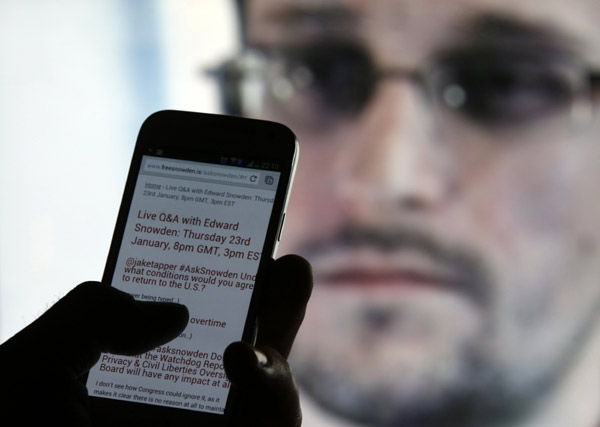
A man uses his cell phone to read updates about former US spy agency contractor Edward Snowden answering users' questions on Twitter in this photo illustration, in Sarajevo, Jan 23, 2014. [Photo/Agencies] |
Following US media reports in late July that the Barack Obama administration plans to take revenge on China for "cyberattacks", Bloomberg reported on Friday that computers of American Airlines and Sabre, a US company which runs an air travel reservation system, might have been attacked by China-based hackers. On Monday NBC news reported that Chinese hackers have been accessing the private emails of top US national security and trade officials since April 2010.
This has raised fear among people that tensions between China and the US may intensify, with some even saying a large-scale cyber warfare seems unavoidable, which, in turn, calls for the need to clarify the concept of cyber warfare. In general, people equate cyber warfare with "destroying enemy telecommunication devices" or "hacking enemy databases" as in a real physical war, which, in fact, is only a small part of it.
Conflicts in cyberspace are not new, and cyber warfare can be defined as activities to gain advantage in public opinion or export ideologies through online channels, or activities to obtain intelligence and carry out surveillance to do so.
The US is a master at both. It has been playing up the "China cyberthreat" theory even while conducting surveillance against its allies, including Germany and Japan - and WikiLeaks has exposed the dark side of the US by releasing classified documents.
Cyber warfare is asymmetric, because even a single hacker can launch an attack against a state. "No absolute security" is a quote often used by cybersecurity experts. This asymmetry is also a threat to the existing world order, because weaker states or organizations can harm the interests of regional and even global powers, and vice-versa. The difficulty in locating the attacker is the main reason behind this asymmetry.
To fully secure itself, the US has been developing a shield against the invisible spear of cyberattack. It has already listed web-tracking as a priority research area and making progress. For example, it was reported that the US traced the source of the attack on Sony to the Democratic People's Republic of Korea because of the bugs in the DPRK's monitoring system. The US is also believed to have installed thousands of programs in China's computer networks that can alert the US against cyberattacks in advance.
Another tactic to thwart attacks is to put potential attackers under pressure. The US' latest cyber strategy - of imposing economic sanctions, initiating judicial action and even launching military strikes against attackers - is designed to deter opponents from launching attacks. The New York Times has reported that Washington's "revenge" may also include attacks on key targets in China and stealing information from it.
So, what can China do to establish an active rapid response system? The newly established central Internet security and information group, headed by top leader Xi Jinping, can mobilize enough resources and coordinate with relevant departments to deal with emergencies. The departments include public security agencies to analyze attacks, diplomatic organizations to deal with the problems diplomatically, and publicity departments to prevent rumors from creating chaos in the public.
Like the US, China also needs to develop its cyber defense technology in order to deter potential attackers, with online tracking technology being a key part of the process so that the location (and perhaps identity) of the attacker can be known. It should also unambiguously declare its cyberspace sovereignty through key strategic documents, which offer legal basis for China to defend its cyberspace.
Moreover, China should more actively participate in global cooperation on cybersecurity, and strengthen dialogues and coordination with Russia, the US and the European Union. Also, drafting an international covenant against cyber warfare would be in the great interest of China and send the international community a clear signal about China's stance on cybersecurity, as well as its determination to defend itself against attacks.
The author is a researcher in cybersecurity at CCID Think Tank, affiliated to the Ministry of Industry and Information Technology.


I’ve lived in China for quite a considerable time including my graduate school years, travelled and worked in a few cities and still choose my destination taking into consideration the density of smog or PM2.5 particulate matter in the region.
Copyright 1995 - . All rights reserved. The content (including but not limited to text, photo, multimedia information, etc) published in this site belongs to China Daily Information Co (CDIC). Without written authorization from CDIC, such content shall not be republished or used in any form. Note: Browsers with 1024*768 or higher resolution are suggested for this site.
License for publishing multimedia online 0108263 Registration Number: 130349