 |
|
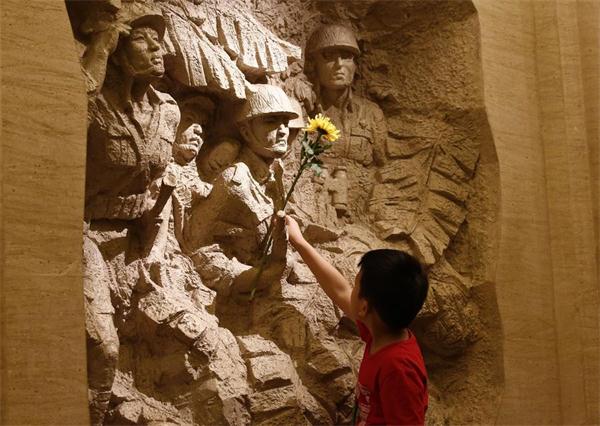
A boy places a flower on a sculpture depicting China's anti-Japanese war fighters during the World War Two, at the museum of the war of Chinese people's resistance against Japanese aggression in Beijing September 3, 2014, on the day that China marks as the anniversary of its World War Two victory over Japan. [Photo/Agencies] |
China's contribution to the overall Allied victory during World War II is a topic that is gaining increasing historical attention in the West. I was motivated to write a book about China's wartime role (China's War with Japan, 1937-1945: The Struggle for Survival - US title, Forgotten Ally) because I felt the significance of the Chinese contribution to World War II was not sufficiently understood in the West. To understand this significance, we need to consider the alternative possibilities during one of the worst years of the war, 1938.
A year after the war broke out at the Marco Polo Bridge near Beijing in July 1937, much of eastern China lay in Japanese hands. In late October, the temporary military headquarters at Wuhan, Hubei province, fell to the enemy. Many outside observers assumed that China could not hold out.
Yet China did not surrender. Although it had little assistance from the outside world, barring some military aid from the USSR, both the Kuomintang and Communist leaderships continued to plan for resistance. But if Chiang Kai-shek's government had made a different decision in 1938, then China's fate would have been very different. If China had surrendered in 1938, Japan would essentially have treated China as a colony. Japan's forces would also have been freed for an all-out assault on the USSR, Southeast Asia, or even British India.
The Western powers did come to realize China's value. By 1940, significant unofficial flows of finance and supplies were coming to China. By that year, Britain was at war with Germany, and the US was becoming increasingly aware that its Pacific position was in danger from Japan.
On Dec 7 1941, the Japanese attacked Pearl Harbor and the war became genuinely global, in particular when Adolf Hitler declared war on the US just a week later. Yet there remained a difference between the Western and Chinese views of their roles in the war.
In the Allied view, China was a victim. It had been invaded and deserved sympathy. But in the end, they believed that its most important role was to act as a barrier to further Japanese action in Asia. The Chinese resistance was holding down 600,000 or more Japanese troops. In the early part of the war, this meant that those troops could therefore not be transferred to the rest of Asia easily. But the Americans and British knew that the Chinese Nationalist armies were weakened by four years of resistance and could not easily be deployed outside China itself. Chiang Kai-shek's regime was weakened greatly from within, as corruption, bureaucratic incompetence and sheer exhaustion ate away at its strength.
The view of the Western allies was perfectly logical. But the problem was that the West failed to understand how the war looked through Chinese eyes. For the Nationalists and Communists, the war had begun in 1937, that is, four years before Pearl Harbor. It was true that China's armies were weak, but many of the best troops had been sacrificed in major battles such as Shanghai and Xuzhou. It was also true that the government was inefficient and corrupt, and that the economy was in a bad shape.
However, China's capital had moved to Chongqing at high speed, the city had been flattened by repeated air raids, and the government had been isolated from much of the outside world for years, making it impossible to run a normal administration.
China's war efforts need to be understood in its own terms, and commemorated for the right reasons. China could not have won the war on its own. To defeat Japan, it had to rely on Western, and in particular, American finance, military support and supplies. Also, it was reasonable that the Allies set priorities: first Europe, then the Pacific, then China. But the West did not acknowledge that China's contributions were also crucial to the war effort. China resisted in 1938 when it could have surrendered before the war in Europe even started. It held down huge numbers of Japanese troops on its territory. It acted as a beacon to other non-Western countries, showing that it was possible to fight with the West and still strongly oppose imperialism.
There are many lessons that can be learned from China's experience during World War II. One is the importance of new and creative political dialogue. During much of the war, there were significant and free-ranging political discussions between China's major and minor political actors on many issues from greater democratic representation to postwar internationalism.
Another key lesson was the importance of strong but flexible organizations in the region. China and Japan went to war in part because of the failure of the international system. Today, the US, China and Japan need to work on a consensual, open and mutually agreed institutions that would overcome the legacy of those failures.
The author is director of the China Centre at Oxford University and his most recent book is: China's War with Japan, 1937-1945: The Struggle for Survival (US title: Forgotten Ally).


I’ve lived in China for quite a considerable time including my graduate school years, travelled and worked in a few cities and still choose my destination taking into consideration the density of smog or PM2.5 particulate matter in the region.
Copyright 1995 - . All rights reserved. The content (including but not limited to text, photo, multimedia information, etc) published in this site belongs to China Daily Information Co (CDIC). Without written authorization from CDIC, such content shall not be republished or used in any form. Note: Browsers with 1024*768 or higher resolution are suggested for this site.
License for publishing multimedia online 0108263 Registration Number: 130349