 |
|
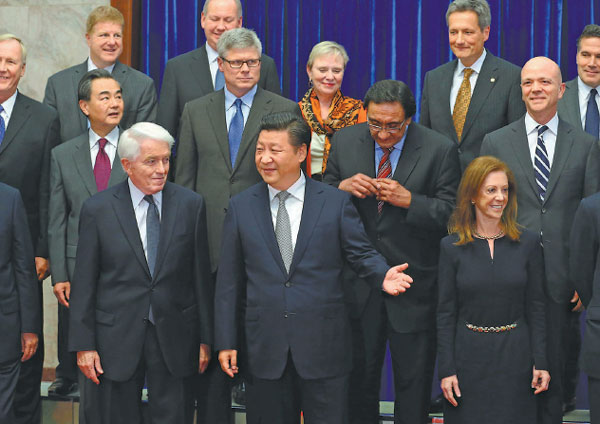
President Xi Jinping poses for a group photo with members of a United States delegation taking part in a China-US business leaders' dialogue in Beijing on Thursday. [Photo/ China Daily] |
The China-US relationship is regarded as one of most important for the 21st century. Yet it is also one of the most complex and challenging relationships.
The two countries are now bound together by an extraordinary level of economic interdependence. They have become one of the top trading partners of each other, with two-way trade doubling in the past decade. Direct investment from Chinese companies in the United States has increased five times since 2009, creating more than 80,000 jobs across the US.
People-to-people exchange is thriving. There is a flight between China and the US every 17 minutes on average. The US is the favorite destination of Chinese students, tourists and business travelers. The extension last year of travel and business visas to 10 years is creating a new boom in the two-way flow of people.
On the regional and international fronts, the joint efforts of China and the US are doing enormous good not only for the two countries, but also for the rest of the world, be it facilitating the comprehensive nuclear deal on Iran, leading global negotiations to tackle climate change, or responding to the Ebola epidemic in Africa. Such common interests and responsibilities have tied the two countries together and made the cost of an all-out confrontation all but unbearable for either of them.
Despite its success, however, the China-US relationship is confronted with complex challenges. One source of constant friction is the fundamental difference in their ideologies. In the eyes of the Chinese, the US has not given up attempts to turn China into a Western-style "democracy", whereas the patience of China, ever more confident of the strengths of its political system, is dwindling when it comes to listening to the US' lectures on human rights.
Another source of deep-seated mistrust is their perceptions of geostrategic rivalry, which has very much colored the US' views of China, and vice versa.
Take the South China Sea issue for example. What is seen by China as legitimate and defensive construction on its own islands and reefs is viewed by the US as a provocative attempt to seek regional domination.
China proposed the Asian Infrastructure Investment Bank to address the woeful lack of infrastructure funding across the world, especially in neighboring countries, yet the US sees it as part of a wider plot to undermine the existing international financial system.
Conversely, the US' rebalancing to Asia strategy and Trans-Pacific Partnership are widely perceived as an instrument of containment and exclusion of China.
In this context, President Xi Jinping's state visit to the US will be a major opportunity to reaffirm shared commitments to building a "new model of major-country relationship", and put bilateral ties on the steady tracks of cooperation. President Xi's visit will give both sides a chance to build on their discussions in Sunnylands, California, and Zhongnanhai, Beijing, to deepen mutual trust through strategic communication and present a positive narrative of China-US relations.
China remains committed to peaceful development and has no intention of replacing the US as a hegemon in the Asia-Pacific region. On its part, the US should welcome China's rise and be more open toward a China that is ever more capable and ready to protect its vital interests and have a greater say in regional and international affairs.
The two sides should explore ways for healthy interactions in the Asia Pacific, and the US should make its alliances more open and inclusive, and better reflect the trend of the times.
China should reaffirm its peaceful intentions in the South China Sea, and the US should support China and ASEAN member states in advancing discussions on the Code of Conduct in the South China Sea, and not take the side of its allies at every turn.
China needs to reaffirm its commitment to economic structural reform and opening-up, while the US should work with China for the progress of the Sino-American Bilateral Investment Treaty negotiations and address China's concerns on investment obstacles and restrictions on high-tech exports.
The US also needs to approach China's Belt and Road Initiative from a win-win perspective and support the development of the AIIB.
Cyberspace should become an area of cooperation rather than conflict between the two countries. As the recent high-level agreement on fighting cyber crimes shows, cooperation in law enforcement and rule making is the right way forward.
On many occasions, President Xi has said the Pacific Ocean is large enough to accommodate both China and the US. And US President Barack Obama has repeatedly stated that the US welcomes a strong, prosperous and successful China that plays a greater role in world affairs. China and the US must work together to fulfill their shared responsibility of making the world a better place. The world will be watching to see if they can deliver on that when President Xi visits the US.
The author is a researcher with the Foreign Ministry.


I’ve lived in China for quite a considerable time including my graduate school years, travelled and worked in a few cities and still choose my destination taking into consideration the density of smog or PM2.5 particulate matter in the region.
Copyright 1995 - . All rights reserved. The content (including but not limited to text, photo, multimedia information, etc) published in this site belongs to China Daily Information Co (CDIC). Without written authorization from CDIC, such content shall not be republished or used in any form. Note: Browsers with 1024*768 or higher resolution are suggested for this site.
License for publishing multimedia online 0108263 Registration Number: 130349