 |
|
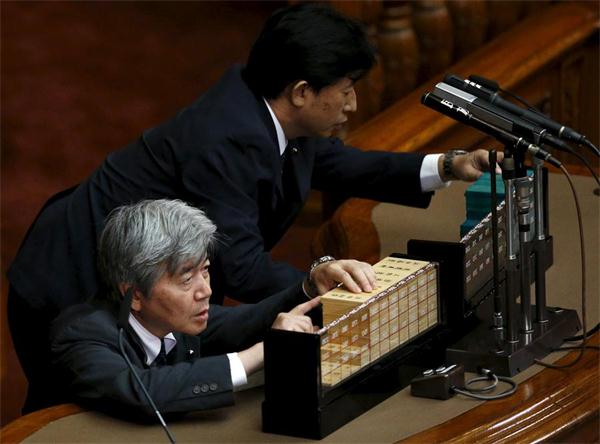
Parliament staff members count the number of votes for the security bills during the plenary session at the Upper House of the parliament in Tokyo, Japan, September 19, 2015. Japan's parliament voted into law on Saturday a defence policy shift that could let troops fight overseas for the first time since 1945, a milestone in Prime Minister Shinzo Abe's push to loosen the limits of the pacifist constitution on the military. [Photo/Agencies] |
The approval of two security bills by Japan's upper house in the small hours of Saturday marked a historic shift in the country's defense-only security policy. The ruling coalition of the Liberal Democratic Party and Komeito Party, which have majority in parliament, railroaded the bills through both houses ignoring the unusually large rallies against the bills and Japanese Prime Minister Shinzo Abe himself.
Japan's lower house passed the bills on July 16.
By changing the core of Japan's defense policy, the Abe administration has succeeded in breaking with the country's post-World War II policies. Major features of the legislation are seen by many experts and lawyers as violating Japan's pacifist Constitution, especially the "no war" Article 9. But Abe's right-wing supporters have ignored everything.
The deliberation process turned out to be far rockier than Abe anticipated. In particular, the discourse on the security legislation became increasingly confrontational after June 4, when all three respected constitutional scholars who testified at the special committee on the Constitution said they believed the proposed legislation package was unconstitutional.
Then Abe and the LDP lawmakers made China the case for the bills. In the last round of the debate when every party made a 15-minute presentation in the early hours of Saturday, LDP's Junichi Ishii came up with the "China threat" theory again.
Motofumi Asai, a Japanese veteran diplomat and international relations scholar, says the Abe administration has always used China and the Democratic People's Republic of Korea as immediate threats to Japan. Abe wants to resolve the issue of Japanese citizens' abduction by the DPRK, but instead of focusing on Pyongyang he is targeting China.
Asai has hit the nail on the head.
Japan's foreign ministry released photographs of China's drilling platforms in the East China Sea last week exactly when lawmakers from some opposition parties were challenging the Abe administration-sponsored security legislation in the upper house. But despite this, the Abe administration's "China threat" tactics failed to win public support.
Opinion polls showed that a majority of Japanese voters oppose the legislation that allows the country's Self-Defense Forces to exercise the right to collective self-defense, which is a violation of the Constitution.
Japanese people are fully aware of what Abe is doing; they also know he is not likely to strengthen Japan's security or advance peace and stability in East Asia and the rest of the world. His collective self-defense doctrine is inseparable from the Japan-US alliance and the strategies of the Pentagon. It is aimed at integrating Japanese armed forces into the plans, strategies and operations of US forces around the world.
When Abe visited Washington in April, Japan and the US signed a revised defense guideline, the first change since 1997. The revision boosts Japan's role in missile defense, mine sweeping and ship inspections amid "growing Chinese assertiveness" in the East and South China seas. The new arrangement also allows Japan to dispatch its forces beyond the region as logistic backup for US military's global operations, in distant areas including the Middle East.
The new version of the Japan-US defense guideline is subject to Japan's latest security legislation. Now that the Japanese upper house has passed the security bills, they could be enacted within six months.
Winning another three-year term as LDP president by silencing his rivals within the party, Abe could remain prime minister until 2018 when the next general election is due. And he could increase the chances of fulfilling his cherished goal of constitutional amendment after the elections to the upper house next summer.
The author is China Daily's Tokyo bureau chief. caihong@chinadaily.com.cn


I’ve lived in China for quite a considerable time including my graduate school years, travelled and worked in a few cities and still choose my destination taking into consideration the density of smog or PM2.5 particulate matter in the region.
Copyright 1995 - . All rights reserved. The content (including but not limited to text, photo, multimedia information, etc) published in this site belongs to China Daily Information Co (CDIC). Without written authorization from CDIC, such content shall not be republished or used in any form. Note: Browsers with 1024*768 or higher resolution are suggested for this site.
License for publishing multimedia online 0108263 Registration Number: 130349